
Is It Morally Wrong To Buy Homes To Be Short Term Rentals?
Recently I have gotten some negative feedback about turning 2 homes in my neighborhood into short term rentals. Let’s examine what I have done and how that fits into the broader question about short term rentals in America and Southwest Michigan.
My Experience:
In 2024 I bought a home in our neighborhood that needed substantial work. It would not have qualified for a conventional loan and I paid all cash for it. The roof needed replaced, the siding needed replaced, the subfloor needed replace, the flooring needed replaced, I had to re-texture all the walls, the bathroom needed redone, the kitchen needed redone, A bedroom ceiling had collapsed, it needed treatment for termites, it needed gutters, and there were a thousand other small jobs. Not only this, but the property was being sold due to divorce proceedings and the house was left full of stuff, with the ex-husband needing to come back to get his guns after closing. This home could not have been sold to the typical home buyer who planned to live in the house.
I paid $95,000 for the home, let’s call it $100,000 with closing costs. I then spent $60,000 and between Mrs. C. and I over 1,000 hours across a year of our lives fixing the property up. Our long term plan is to sell this property to one of our children so they can live in the same neighborhood. Our neighborhood consists of approx. 35 houses and it is rare that homes come up for sale, when they do, they recently have been very expensive with the median cost being over $250,000. It is highly unlikely that when it makes sense for them to buy a house here they will have the ability, both due to the cost and limited availability. This gave us the opportunity to lock in a house at a low cost.
The 2nd house we bought in our neighborhood needed far less work. This house was listed below recent comps and I can see it from my house. The house is a 3 bedroom 1 bath that we paid $165,000 for. The idea behind this was that it was almost move in ready and since we paid effectively $160,000 for the other 3 bedroom 1 bath PLUS a year of our labor, it makes sense to buy this one that needs only a week or two of labor at effectively the same price. To some extent it isn’t a straight comparison because the first house had the pole barn and is a coupe hundred square feet larger.
Once again, we have 4 children and 3 of them would like to live in this neighborhood long term. Securing the houses now preserves that option and locks in a long term low cost. In the near term this is also beneficial to us to diversify our investment dollars, as most of our investment dollars are located in Benton Harbor/Benton Township.
Why STR Vs. Long Term Rental:
I could have these houses as a long term rental instead, however for the time being we have decided to set them up as short term rentals.
- I have far more control: With short term rentals the guests get feedback ratings. If they receive too many negative ratings they can be removed from the program or hosts can decide not to let them stay at their properties. Hosts can assign house rules that are more likely to be followed than lease terms.
- I get the house back: With a normal rental I only get the house back after a year, or 2, or 5. Generally when I get the property back there is a mountain of work to do because most of the time tenants don’t treat a property great. With STRs I get the property back every few weeks or every few months and generally not a lot of damage is done. I also get the opportunity during our slow season to make upgrades.
- The laws favor STRs: Michigan treats landlords of long term tenants terribly. It takes forever to evict someone, you can’t enforce late fees, it is easy for tenants to run up a large bill and stiff the landlord, and they can do significant property damage with little recourse. With STRs they pay in advance and most platforms offer insurance in case guests are destructive.
- In theory I can make more money off of an STR: A house that I could rent out for around $1,500 to $1,800 a month can rent for closer to $3,000 a month.
- I’m solving a problem I have had, lodging while living on the road. Try living in a hotel for 3 months while working 12 hour shifts, especially night shifts. Its next to impossible to have the family come to visit, and it is a common occurrence to be awakened by noise from other hotel guests. STRs are not just for vacations, they are often used by travelling workers.
The Criticism:
This is nothing new. Some people are against homes being rental properties at all, while others are only against short term rentals. They claim that home owners stabilize the neighborhood and that homes should be for families, not for hotels. They claim that short term rentals will be loud party houses.
The Response:
In my situation, the homes are owned, and they are not corporate owned or owned by a Chicago landlord 100 miles away. They are owned by people in our neighborhood. I drive or walk by these houses every day and address any issues immediately. Mrs. C. and I are the ones cleaning the properties between guests. Both homes are in better repair than my house and most houses in the neighborhood. These properties need to consistently be in good condition and curb appeal in order to maintain positive reviews, which ensures they will be more stabilized than the average property.
We do not allow single night rentals, which eliminates 90%+ of people who would want to host parties. Being outside of the city also lowers that likelihood. Airbnb strictly prohibits parties in their rules and regulations. So far we have had zero parties in our 2 single family homes and in our 6 unit in Benton Township we have had 2 parties in 4 years of operation with 6 units. Both of those guests were blocked and the reason we switched to not allowing single night stays. Since we made that move we have had zero issues with parties. Currently one of the houses has a guest staying for 3 months while the other one has a guest staying for a month.
The current use (STR) is far better than no use, which is the condition of 2 other homes in our neighborhood. There currently is a home in our neighborhood that an investor owns that has been empty for the entire time we have lived here (15 years). Another home on our neighborhood is owner occupied, but he is only there part time, the windows are boarded up and the yard is in disarray. There are also 4 buildable lots in our neighborhood that are not side lots owned by adjacent home owners. These 4 lots could have homes built on them but don’t. Only 1 of these lots had previously had a home on it, which burned down several years ago.
Critics state that homes should be for families. If homes are for families, what about single individuals living in 3 bedroom homes? Several of the homes in our community are owned by single individuals. 1 person in a house designed for 4 to 6 people. I would argue that this is a worse use case than short term rentals. Throughout a calendar year one of our properties likely averages 3 to 4 people per day in it, compared to these houses averaging 1 or 2 people per day.
There is a far greater problem in our housing situation than short term rentals existing, and that is the under utilization of housing. I personally don’t think anything is morally or ethically wrong with 1 person living in a 3 to 4 bedroom single family home (so long as they are paying for it), but that certainly reduces the number of single family homes available for families much more than short term rentals and therefore increases the cost of housing much more than sing family homes being used as short term rentals. The majority of homes in our neighborhood do not have children.
There are roughly 86 million single family homes in the US. The highest estimate for total number of short term rentals in the country is 2.5 million and that includes apartments, like our 6 unit short term rental building. Approximately 30% of total housing units in the US are multifamily, so it would stand to reason that roughly 30% of short term rentals are in multifamily buildings, and that we are outliers with 75% of our STRs being in multifamily buildings. This would put the high end of single family homes used as short term rentals at 1.75 million homes, or 2% of the single family homes in the US.
Most of the short term rentals we get are for 3 or more people and many of the stays are for several weeks at a time.
According to the US Census bureau:
- 21.2 Million Single family homes are occupied by 1 person.
- 29.5 Million Single family homes are occupied by 2 people.
Combined this is 25 times the amount of single family homes used as short term rentals. This is 58% of all single family homes in the US. Homes for families are unaffordable? Yeah, it’s because Grandma and Grandpa got divorced and both live alone in 3 bedroom houses.
A third of adults over 65 live alone today in the US. In 1950 only 10% of those over 65 lived alone. Today 16.9% of the population is over 65 Vs 8.1% of the population in 1950. In 1950 there were 13 million adults over 65, with 10% living alone this was 1.3 million people. Today there are 54.1 million people over 65, with 33% living alone this is 17.8 million people! This is over 13 times the amount of elderly living alone our country had in 1950.
The next biggest issue with housing? Illegal Immigration.
Current estimates put total illegal immigrants in the country at around 15 million people. How many housing units do you think they take up? Likely more than the 2.5 million short term rentals. At the US average of 2.5 people per housing unit this would be 6 million housing units.
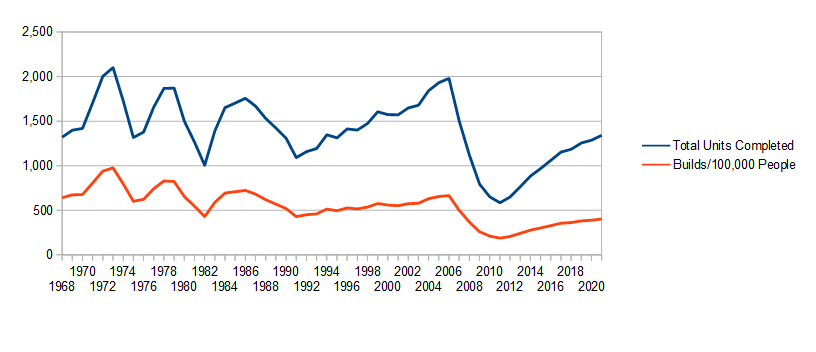
Of course I missed the largest issue: We have had NIMBYs preventing home building for the last 4 decades.
- Tons of zoning limiting construction to single family homes on large lots.
- Zoning preventing any residential in many areas.
- Town hall meetings deciding by mob mentality what developments on private land can be built.
- Extreme additions to regulations and building codes including high minimum square footage and minimum parking requirements.
- Regulations that prevent owning a mobile home or starting a mobile home park
- Regulations that prevent converting space into residential usage

Short Term Rentals In Southwest Michigan:
Southwest Michigan has a large need for temporary lodging. We are a tourist mecca for Chicago people and we bring in large amounts of temporary workers to support the two nuclear power plants in our area, DC Cook and Palisades. Palisades is in a multi-year restart effort that has seen several hundred workers brought in for many months at a time to support this work.
Several municipalities in our area have either outright banned short term rentals or made them almost impossible to get. Recently the city of St. Joseph denied a request to allow an 8 unit apartment building next to a hotel to operate as a short term rental. They would not even entertain allowing the owner to have half the units as short term rentals.
The Market:
Ultimately all of these critics had the opportunity to purchase these homes. These houses were listed on the MLS and were listed for multiple days. The critics could have paid $100,000 of their cash to buy the first one, or got a mortgage on the 2nd one and made a down payment of over $50,000, then turned around and sold to only an “owner occupant”.
Aside from putting their own money at risk, they could have discussed with their neighbors before they listed their homes their concerns and got them to buy in on the idea of only selling to an owner occupant. They could have encouraged owner occupants to put in an offer on the homes that would have been better than mine. After all, an owner occupant can put down 3.5% on a home, so rather than putting down over $40,000 like I did on the 2nd home, they would have only had to put down $6,000.
Do you have any short term rentals? DO you think short term rentals for single family homes should be banned? If so are there other forms of home utilization that should be banned?
Leave a Reply