
Is Paying Kids To Attend School Reasonable?
My local school district, Benton Harbor Area Schools, is now running a program to pay all high school kids who sign up $100 per week for perfect attendance for a 10 week period of time. There is a 1 week break in the program during count week, where the school can not legally do this. The idea here is to combat the heavy absenteeism that is occurring with over 80% of high school students being labelled as “chronic absentee” which is defined as missing 10% or more of scheduled school days. Is this a good policy? and if it is, should we do it with more aspects of our kids education? I will add in that there is some disagreement as to whether the absenteeism figures are correct. 1 person during the board meeting questioned whether attendance was being properly logged at each class by the instructors.
The Cost:
Benton Harbor has 506 total high school students and students must opt in to this program. The theoretical maximum cost is therefor $506,000 for the 10 week program. If this were across the entire school year it would be closer to $2,000,000. Not all students opted in, the opt in option was not open for a very long time, so not all students made it. Likewise most students will not go 10 weeks without missing a day. Accounting for this, I think 60% of the total cost, something like $300,000 is more likely.
Where does the money come from? In the 3 hour school board meeting (at this link) The discussion on this topic starts at 1:22:30. The director of finance did not give a valuation for the cost, and stated that the funds were coming from the general fund and that the district can definitely sustain this program. She stated when they had the number of student participation count, then a budget item will be earmarked for this program.
Benton Harbor primarily receives its funding from two sources, the Michigan state per pupil funding, which is just shy of $10,000 per student per year, and from property taxes. School districts have a monopoly to collect property tax revenue from all real estate that is non homesteaded in the defined boundaries of the district. This includes all commercial properties, 2nd homes, rental properties and vacant lots not adjoining the primary residence of the owner. They charge an 18 mill tax, which is $1,800 per year for a property with a market value of $200,000. Benton Harbor school district covers a massive 58 square mile spread, far greater than nearby St. Joseph with 16, Coloma with 42, and Eau Clare with 49.
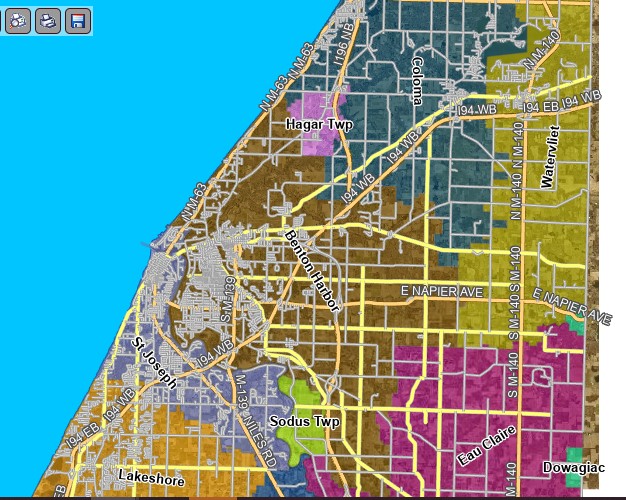
Benton Harbor Area Schools recently received a $10 million gift from the State of Michigan by “forgiving” its debt, which was really a transfer of the debt from the people who live in Benton Harbor school district to the taxpayers of the entire state.
Benton Harbor has a few major advantages on the property tax front.
- The School district includes the two headquarter buildings of Whirlpool corporation, with total taxable value of over $30 million.
- The School district includes a large portion of the Harbor Shores Golf course development, which encompasses hundreds of high dollar homes.
- Roughly 2/3 of households in Benton Harbor are renter occupied.
- The district spans 5 miles along Lake Michigan. Most of these are $2 Million+ 2nd homes of very wealthy people.
- Benton Harbor Assessors routinely over assess properties. Two years ago I bought a property for $35,000 and they claim it is worth almost $100,000. Two subsequent appeals have been rejected.
- Long dropping student count: Benton Harbor does not educate the majority of the children in the district. Ever since there was been a mechanism for people to get their children out of Benton Harbor schools they have done so. Between Charter schools and School of Choice, Benton Harbor enrollment has fallen steadily over the past 27 years, with over 6,000 total students in 1998 and only 1,300 students in 2024. The total dollars received from property taxes doesn’t go down, but the student population has been cut by 80%. In general it should be less expensive to educate fewer students. Benton Harbor still receives 100% of the property tax revenue for the district, while educating roughly 25% of the students in the district. (1,296.1 out of 4,726.7)
Benton Harbor area schools spends $29,162 per student, almost twice the state average of $17,500. ($37,797,200 total spending divided by 1,296.1 students for 2024 from mischooldata.org)
The part that frustrated me is how uninterested the entire board was in discussing where the money was coming from and how much the total cost would be. Surely they could do the napkin math and see an upper limit cost of almost $500,000. Just accepting that its from the general fund and the director of finance says its sustainable doesn’t feel rigorous enough. I would have expected the roll out for something like this to have detailed information of the total cost, what the current unallocated funds are and what other options the district has for this amount of spending.
According to the 2025-2026 Initial Budget, Benton Harbor Schools had a fund balance of $24,800,000 at the start of the year, with projected revenue of $24,484,220 and expenses of $31,884,579. The fund balance has been built up over the last 5 years largely due to large federal and state payments that are now declining. With a projected $7.4 million deficit, an increase from last years $4.3 million deficit, it would stand to reason that BHSD would be working to saved every dime to cut the deficit, rather than openly spending additional funds. Yes there is money in the bank account, but at the current rate in 4 years there will not be any money in the bank account and BHSD will be running a $7 to $10 million deficit.
On a macro level across the state if we implemented this for all students for the entire school year this would cost $4,000 per student and increase K-12 spending by 22.8%. Each student would be bringing home $100 per week to the household. If we did it for only all high school students it would increase total state spending on K-12 by 7%.
Is Paying Kids To Show Up Reasonable?:
Proponents of this plan say that this solves multiple problems and provides life lessons for teens. The idea is that school is a job for the students and they are earning this money by showing up. They say that this puts cash in the hands of low income households. It’s trying SOMETHING different, an experiment to see what will yield success. Trustee Angela Doyle stated “I have been saying for a while – we need to think outside of the box. We cannot just continue to do the same thing because the same thing is not working for us.” I agree with Trustee Doyle that practical experimentation is important and that the current situation is not successful.
Initially I saw it as a waste of money, however since I strongly believe K-12 schooling is largely a waste of time, and a grievous misallocation of resources for the state and the students, I can see where this idea has merit. Because the State is requiring students to be stuck in this building receiving no tangible, obvious economic value, then the state should be compensating them for the opportunity cost of not being able to earn money with their time. The state also puts large restrictions on their labor outside of schooling, which makes it even less likely for them to be able to earn money through employment. They also reduce the ability for teens to be employed by setting a high minimum wage in our state. From an ethical standpoint these payments are still wrong, because the state doesn’t create money, it takes it from people and then reallocates it as it desires.
Other Attempts:
Recently A study was conducted in New Orleans and Indianapolis in which students were given $50 per week, a total of $2,000 each over the 40 week school year. In this study there were no strings attached. The results were : The students averaged 1.23 more days per semester at school.
Jonathan Johnson the founder and CEO of the Rooted School Foundation who helped facilitate this study at its charter schools was interviewed by NPR on this, here’s an excerpt:
“SUMMERS: Now, some people may hear $2,000 per student per year helped keep them in school an average of 1.23 more days per semester and wonder, is that the most effective use of that kind of money?
JOHNSON: We think it is. There are very few interventions that local governments are funding or that states are funding that have randomized control trial evidence behind them. We think that, you know, if we extend that over a year or against multiple years, there’s a big bang for the buck there.”
Let’s do some math on that bang for the buck. $2,000 spent for a 1.23 day gain in a 90 day semester, effectively states that a day is worth $1,626 and a school year is worth $292,683. A $2,000 intervention for 1.23 more days is a terrible ROI.
The Benton Harbor model is specifically copied from a program Detroit Public Schools enacted last year to reduce their chronic absenteeism, defined as the percentage of students missing 10% or more of total school days. Detroit implemented the same strategy, $100 per week for 10 weeks, with a max of $1,000 per student. The primary difference? Where the money came from.
The money from the Detroit program was financed with interest earned on funds put aside for construction projects, so it did not come from the operating budget.
The results:
““The incentive clearly worked,” he said. “During that period, we have a 2 percentage point improvement in average daily attendance and a 6 percentage point decline in chronic absenteeism. That’s the highest impact we’ve had in high school.” – Nikolai Vitti DPSCD superintendent
Is a 6 percentage point decline in chronic absenteeism worth the money? Detroit public schools has 48,271 students. Divided by 12 grades is 4,022 per grade, or 16,090 for total high school. Each percentage is 161 students. At scale this would be a total of 644 students who missed greater than 18 days in a year who fell bellow this mark, at a total cost for paying 16,090 high school students a maximum of $16,090,000. What do you think of these results vs. the cost?
Alternatives
We need to ask ourselves, is the K-12 system fundamentally broken? There are some great books against our education system including John Gatto’s Dumbing Us Down, and Bryan Caplan’s The Case Against Education. Our system was designed for a world that no longer exists. I would argue even for the world that did exist at the time, the system was terrible. It was designed to make obedient soldiers and factory workers.
The results we have across the nation for the K-12 system is abysmal. Some of these kids can’t read. They can’t start a business and are largely unemployable. The entire system is a waste of time. We can’t really blame the kids for not showing up when they see no actual benefit to being there.
I’ve argued for years that the goal should be to minimize the time schooling takes up to allow for marketable skills training and work while teenagers are still living at home. This provides a backdrop in which they can launch with significant resources, resources that they earned themselves.
Private Online High School:
What if instead we completely eliminated physical high school for all students and had them complete an online high school program, like the Penn Foster program my son did.
(Ad for Penn Foster Here, fits well with teens not wanting to go to school)
The state would pay for the $1,200 cost of the program, and give each child a $250 award for each course finished 21 total course), and a $5,000 launching gift at graduation, with $2,500 in cash and $2,500 deposited into a Roth IRA for the teen. More realistically, the state of Michigan would make its own statewide high school program, at a development cost of something like $5 million, With 1.38 million high school students, roughly 345,000 per grade, this would quickly be a major money saver.
Using the Penn Foster program and the incentives I described would cost $11,450 per student for all of high school, instead of roughly $120,000 for Benton Harbor or $70,000 for the average school . This would also greatly incentivize completion of the program. Most students would finish in under a year. This would give them 3 years of their lives back. The Average duration of the high school program is 14 months, with fast track students finishing in as little as 6 months. Could you imagine saving your child 3.5 years of their life?
In this scenario they are being financially compensation for completing tasks rather than showing up. They are incentivized to complete the program sooner, which will result in them entering the workforce sooner. Under Michigan’s current child labor laws teens age 16 and older are exempt from the restrictions IF they have graduated high school. The law needs to be adjusted to also exempt 15 year olds who have graduated high school.
In those 3 years working full time at minimum wage they would be able to earn $30,000 a year, $90,000 total across the 3 extra years. Since they would still be minors living at home, this money would be able to largely go to savings. I require a 50% minimum savings rate for my kids, but they generally ended up saving around 70%. 70% of $90,000 is $63,000. Can you imagine starting adulthood at 18 with $63,000? I argue that our kids need $85,000 before moving out.
For anyone interested in the Penn Foster high school program but have sticker shock on it being $1,200, they do have a payment plan for $55/mo. We don’t need the government to implement a program of rewards to get our kids to earn a high school diploma. We can do it ourselves by taking our kids out of government schools. Rather than $250 for completing each course, they get a trip to Dairy Queen, or maybe pay $50 per course. Every family can design their own solution.
Vocational Classes with work study:
What if our high schools partnered with local businesses with a work study program? Image 1 of the 6 classes a student takes starting in 9th grade is for HVAC, Mechanics, or Nursing, then during 10th – 12th grade 1 of the 5 days per week they work with local businesses as apprentices/assistants and the businesses pay them a reduced wage below the state minimum wage, something like $10/hr. Each student would earn $70 each week and the employers would be able to train future employees at an extremely low cost. Students who do not show up for school the rest of the week lose the ability to be in the work study program.
What are your thoughts on paying students for attendance? Is it sustainable? What results do you think Benton Harbor will achieve?
Leave a Reply