
The Decline of Benton Harbor Area Schools
Benton Harbor Area Schools is likely headed for bankruptcy in 3 years, but no one is sounding the alarm. Maybe we have gotten so used to BHAS having financial difficulty. Maybe the Federal and State post COVID bailouts have made us too comfortable. Maybe no one is paying attention. It could be all of the above. With current trends in 3 years Benton Harbor Area Schools will have enrollment below 1,100 children and will have fully exhausted its general fund while running a substantial deficit.
The History of the Benton Harbor Area School District:
While a Benton Harbor School District has existed since the founding of Benton Harbor, the district we now today was formed in 1965. This is the school district we will talk about here. On June 17 1965 15 separate districts voted to combine into the Benton Harbor Area School District we have today. These districts all lacked a High School and were sending their students to the Benton Harbor High School, which Benton Harbor charged tuition for. Benton Harbor had struggles with planning for the changing number of students each year.
It seems odd to talk about a time where the Benton Harbor High School was bursting at the seams, but that was the case with 2,150 students in the High School in 1964. This consolidation at the time seemed like a good solve, but long term it had some issues.
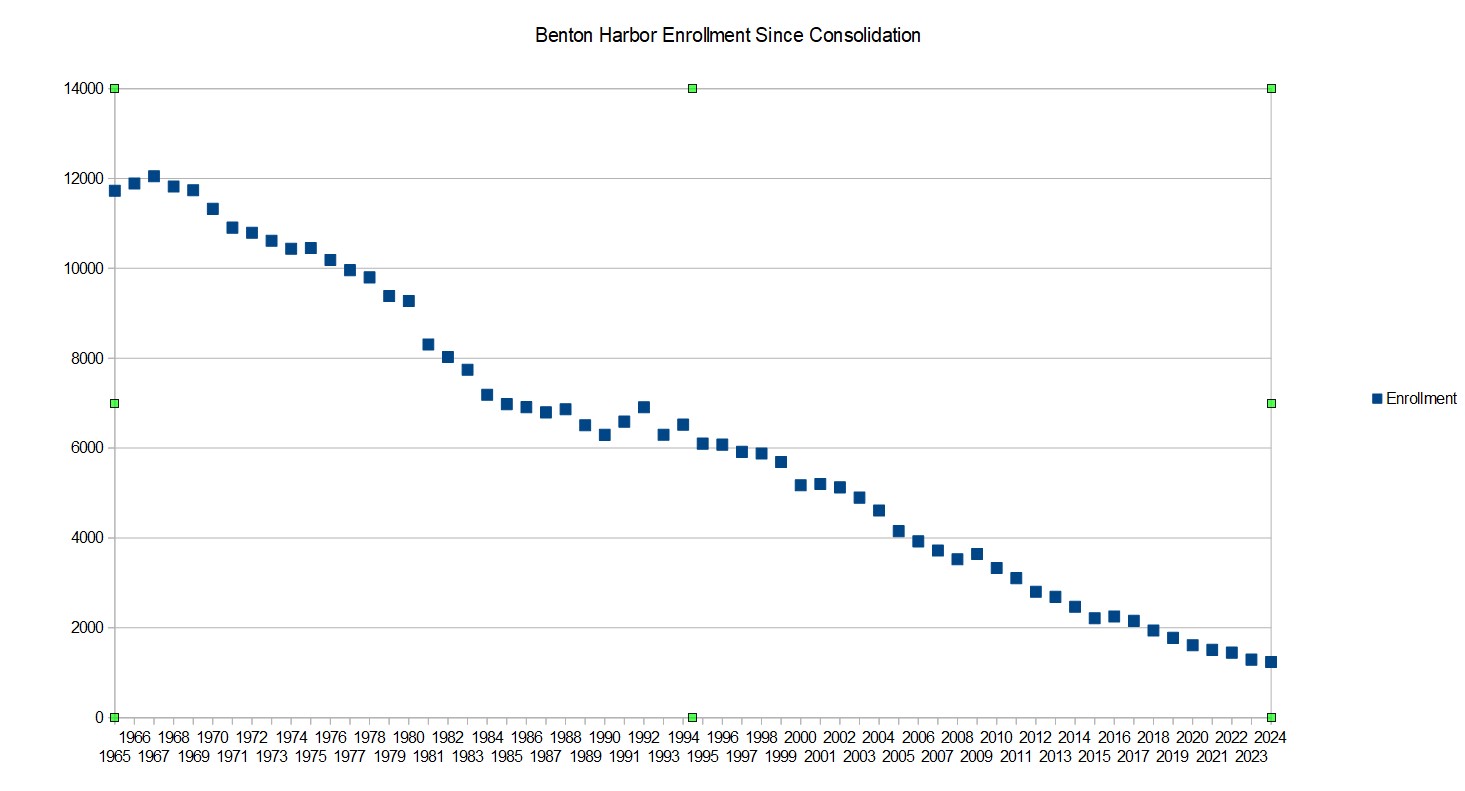
Three years after the school district consolidation in 1965 the student population of Benton Harbor started dropping. Virtually every year since its inception Benton Harbor Area Schools has been losing students. This is also why Benton Harbor ended up with so many buildings. The infrastructure was built for over 12,000 students across 16 different districts, then they all became 1. Prior to the consolidation Benton Harbor was the largest of these districts with 5,129 students in the 1961 school year.
The vote tallying was split into 2 units: Benton Harbor as one and the 15 other districts as one. Each of these groups needed a majority for it to pass, so even if the voters in a single district voted against it, if those in neighboring districts approved it the school would still be consolidated.
Benton Harbor overwhelmingly approved at 1,395 yes to 610 no and the other districts also overwhelmingly approved at 2,527 yes to 936 no.
Consolidating Districts:
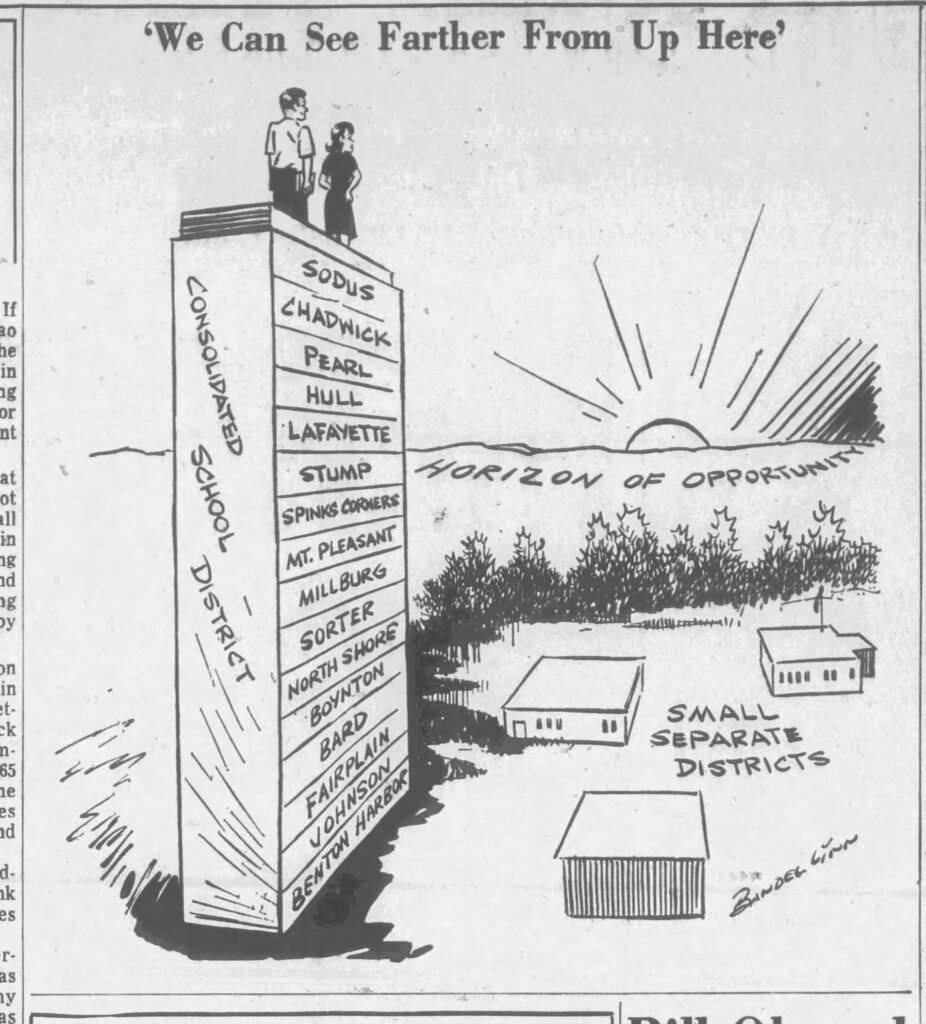
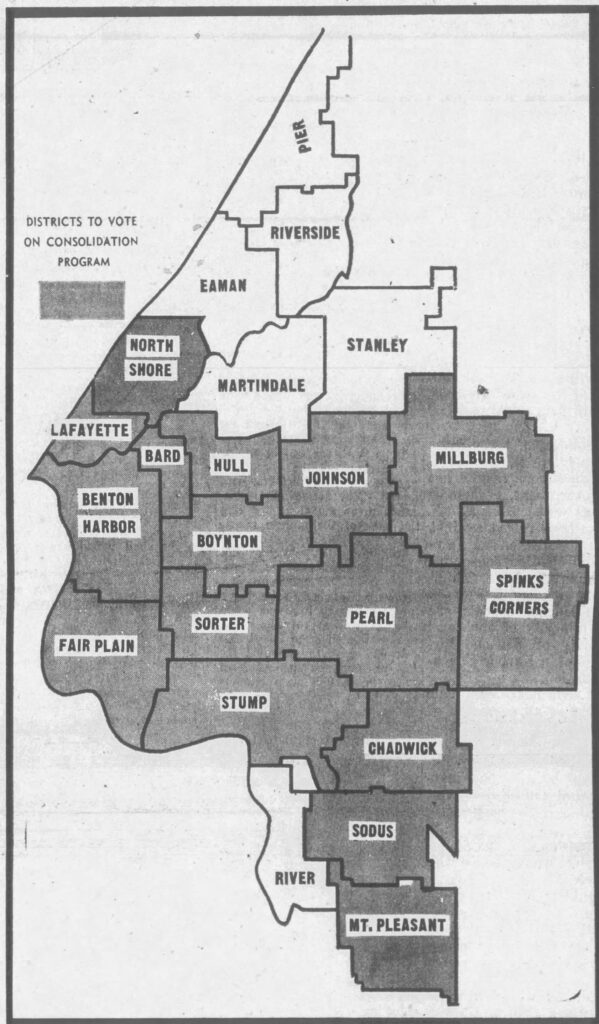
A total of 22 schools in 15 districts were involved
- Bard
- Benton Harbor
- Boynton
- Chadwick
- Fairplain (4 schools)
- Hull
- Johnson
- Lafayette
- Millburg
- Mt. Pleasant
- North Shore
- Pearl
- Sodus
- Sorter
- Spinks Corner
- Stump
An article in the Herald Palladium published after consolidation spoke of an over crowding issue and stated that the Bard school had teacher pupil ratios as high as 50 to 1, about 20 more than desired, indicating that class sizes of 30 were the norm.

Enrollment:
Enrollment peaked 2 years after consolidation in 1967. Since 1967 there has been a steady decline, with a few larger declines. Population decline and an aging population play the larger part in this, but we also have consumer preference. Starting in the mid to late 90s school of choice and charter schools gave parents more options and many took them. Essentially, ever since there has been a mechanism for residents of Benton Harbor to take their children out of Benton Harbor Schools they have done so. As of 2024 Benton Harbor Area Schools had a pupil count of 1,296* with 3,430 resident pupils leaving and only 3 non resident pupils coming. Benton Harbor Area schools is only educating 27.4% of the students who live in the boundaries of the school district. This is down from 32.9% in 2020. They also receive 100% of the property tax money from a large district that includes the world headquarters of a multi-billion dollar company. The per grade breakdown shows actual student count at 1,228 for 2024-25. For the current year it is likely that BHAS is officially at under 10% of the student count it peaked at in 1967.
| 1965 | 11,729 |
| 1966 | 11,890 |
| 1967 | 12,049 |
| 1968 | 11,821 |
| 1969 | 11,740 |
| 1970 | 11,325 |
| 1971 | 10,907 |
| 1972 | 10,793 |
| 1973 | 10,615 |
| 1974 | 10,439 |
| 1975 | 10,452 |
| 1976 | 10,349 |
| 1977 | 10,065 |
| 1978 | 9,734 |
| 1979 | 9,319 |
| 1980 | 9,275 |
| 1981 | 8,308 |
| 1982 | 8,028 |
| 1983 | 7,745 |
| 1984 | 7,312 |
| 1985 | 6,979 |
| 1986 | 6,912 |
| 1987 | 6,795 |
| 1988 | 6,866 |
| 1989 | 6,508 |
| 1990 | 6,295 |
| 1991 | 6,589 |
| 1992 | 6,908 |
| 1993 | 6,297 |
| 1994 | 6,522 |
| 1995 | 6,099 |
| 1996 | 6,077 |
| 1997 | 5,915 |
| 1998 | 5,882 |
| 1999 | 5,690 |
| 2000 | 5,172 |
| 2001 | 5,202 |
| 2002 | 5,127 |
| 2003 | 4,899 |
| 2004 | 4,612 |
| 2005 | 4,153 |
| 2006 | 3,925 |
| 2007 | 3,719 |
| 2008 | 3,525 |
| 2009 | 3,644 |
| 2010 | 3,332 |
| 2011 | 3,105 |
| 2012 | 2,803 |
| 2013 | 2,689 |
| 2014 | 2,468 |
| 2015 | 2,213 |
| 2016 | 2,254 |
| 2017 | 2,155 |
| 2018 | 1,941 |
| 2019 | 1,776 |
| 2020 | 1,613 |
| 2021 | 1,510 |
| 2022 | 1,448 |
| 2023 | 1,314 |
| 2024 | 1,228 |
| 2025 | 1,203 |
*Update: Added the 2025-26 school year on 2/20/26. This showed a major slowing of the enrollment decline. Some good news!
Desegregation Lawsuit: In the late 1970s and early 1980s a long running lawsuit led to Benton Harbor sending Black students to Coloma and Eau Claire with a goal to desegregate the school districts. Several hundred students in the district left each year. This started with the large decrease seen from 1980 to 1981.
In the early 90s Benton Harbor expanded its adult education program and much of the increase blip we see is attributed to that. In 1993 the state law changed making it less economical to offer these courses. The state increased the hours of adult education per year to qualify for state per pupil funding from 480 to 900. In 1995 BHAS laid off 11 adult education teachers.
School Of Choice: School of choice started in 1996 and gave parents the ability to choose where their kids were educated. When school of choice was passed Benton Harbor had a much higher than average crime rate and the school district had many struggles. Parents began electing to send their kids elsewhere when spots were available. The receiving school districts do not receive any of the property tax money, but do receive the per pupil state funding. Effectively they make less per pupil than the rest of their students for school of choice, but are able to fill classrooms that have lower than the max student count with school of choice enrollees.
Charter Schools: A few years later Charter schools became an option in the area with Benton Charter and Countryside both opening in the late 90s. Both of these schools grew and providing bussing services provided more opportunities for students to leave BHAS. A few other smaller charter schools have opened as well, such as the Mildred C Wells Academy.
Declining Population: Benton Harbor’s population peaked in 1960 with 19,136 residents. By 1990 it was at 12,870, and in 2020 had declined to 9,103.
Benton Townships population in 1960 was 16,404. In 2020 it was 14,374.
The county as a whole has also seen a population decline, though not as stark as the city. The population peaked around 1973 at 175,000 people and in 2020 reached 154,000 people.
Declining fertility rate: The US fertility rate in 1960 was 3.65. By 1980 it was cut in half to 1.8 and declined further to 1.6 by 2020. There are too many factors to mention here, but the main point is that far fewer children were born and those children had fewer children. The population decline is effectively exponential. We also have to go back to before 1960. The school district peaked in size in 1967, which would have been about peak baby boom school years. The “baby boom” was from 1946-1964. In 1967 the school would have all the children born between 1949 and 1962.
Negative Demand For Benton Harbor Schools: In addition to the lower population in Benton Harbor city, the school district as a whole is seen as a negative preference when choosing where to live. People are willing to pay more to live in Coloma, Eau Claire, Watervliet, St. Joseph, Lakeshore, or Berrien Springs school districts. There is migration still inside the county, but outside the district.
According to Mischooldata there are 4,726 K-12 students who live in the district with 1,296 being educated at Benton Harbor. Later reports, like the individual grade breakdown show 1,228 students for the 2024-25 school year. The next question is where do the 3,430 remaining kids go to school?
School of Choice:
- St Joseph: 411
- Berrien Springs: 340
- Eau Claire: 252
- Coloma: 246
- Lakeshore: 183
- Watervliet: 95
- Sodus: 47
- Hagar: 45
- Bridgman: 15
- Buchanan: 3
- Niles: 1
- Brandywine: 1
Total: 1,639
Charter Schools:
- Countryside: 748
- Benton Harbor Charter: 419
- Mildred C Wells: 227
- Bridge Academy: 92
Total: 1,486
The remaining 305 must be private school or home schooled and I do not have a breakdown available for that.
Deficits and Bailouts:
Pre 2000 Balanced budgets or small deficits:
1981-82 Budget: Directly after the large amount of students leaving to Coloma and Eau Claire for desegregation Benton Harbor had a budget deficit. Revenue of $18,845,987 vs $19,522,109 Expenses for a deficit of $676,122. This is a 3.5% Deficit. (Compared to 30% in 2025-26). This is in a year where they lost 967 students, the equivalent of 78% of the current student count at BHAS.
1988-89: Revenue $25,796,885 Expenses of $26,557,995. The $761,110 deficit represents 3% of revenue.
1995-96 Budget: $45,275,105 Revenue and $44,952,450 expenses.
1996-97 Budget: $38,086,667 Revenue $37,382,472 expenses. (Did not include $7.6 Million of Title I funds that hits balanced for separate federal and state funded programs)
1999-00 Budget: $41,532,632 Revenue and $41,536,746 in expenses. Note: If I were making a $41.5 million budget, there is NO WAY I would publish it with a $4,114 deficit. I certainly would have found the money. The school district had a reserve account of just over $5 million. This budget also did not include the additional $11 million in Title I grants and balanced spending for that.
2000-2011: The start of modern deficits:
There is certainly a link here between the start of both school of choice and charter schools. I would argue they worked exactly as intended. People chose to move their children out of what they considered a failing district and the district then started failing faster. BHAS did not downsize fast enough to adjust for the loss of students. In most years there are articles where school officials speak optimistically about students coming back. The state also failed by allowing the district to continue to operate deep in the red for so long. I think if the State had tried to help BHAS sooner it could have prevented a lot of the deficit spending.
2001: I did not find the actual budget, but did find a chart showing Benton Harbor spent the 3rd most per pupil in the county, behind only Galien and New Buffalo.
2003: Superintendent Paula Dawning stated the school needs to cut $3 million in expenses this year. She stated “Over the last two years we’ve cut $2.3 million and 50 positions from the district. There’s no fat left. I’m cutting into programs now.”
2004-05: $45.2 million revenue, $46.3 million expenditures
2005-06: $44.1 million revenue, $45.6 million expenditures
The 2007-08 school year had Benton Harbor Area schools with a roughly $3 million deficit. The school spent $40 million with income of $37 million. Retirement payments and reduced student count were the two main factors cited. Retirement payments accounted for 23% of payroll costs and a lost of 168 students cost roughly $1.4 million in state funds.
2008-2009: The district was running a roughly $2 million deficit. The school Superintendent opposed cuts, despite at least 1 school board trustee Leroy Harvey pushing to make more aggressive cuts sooner.
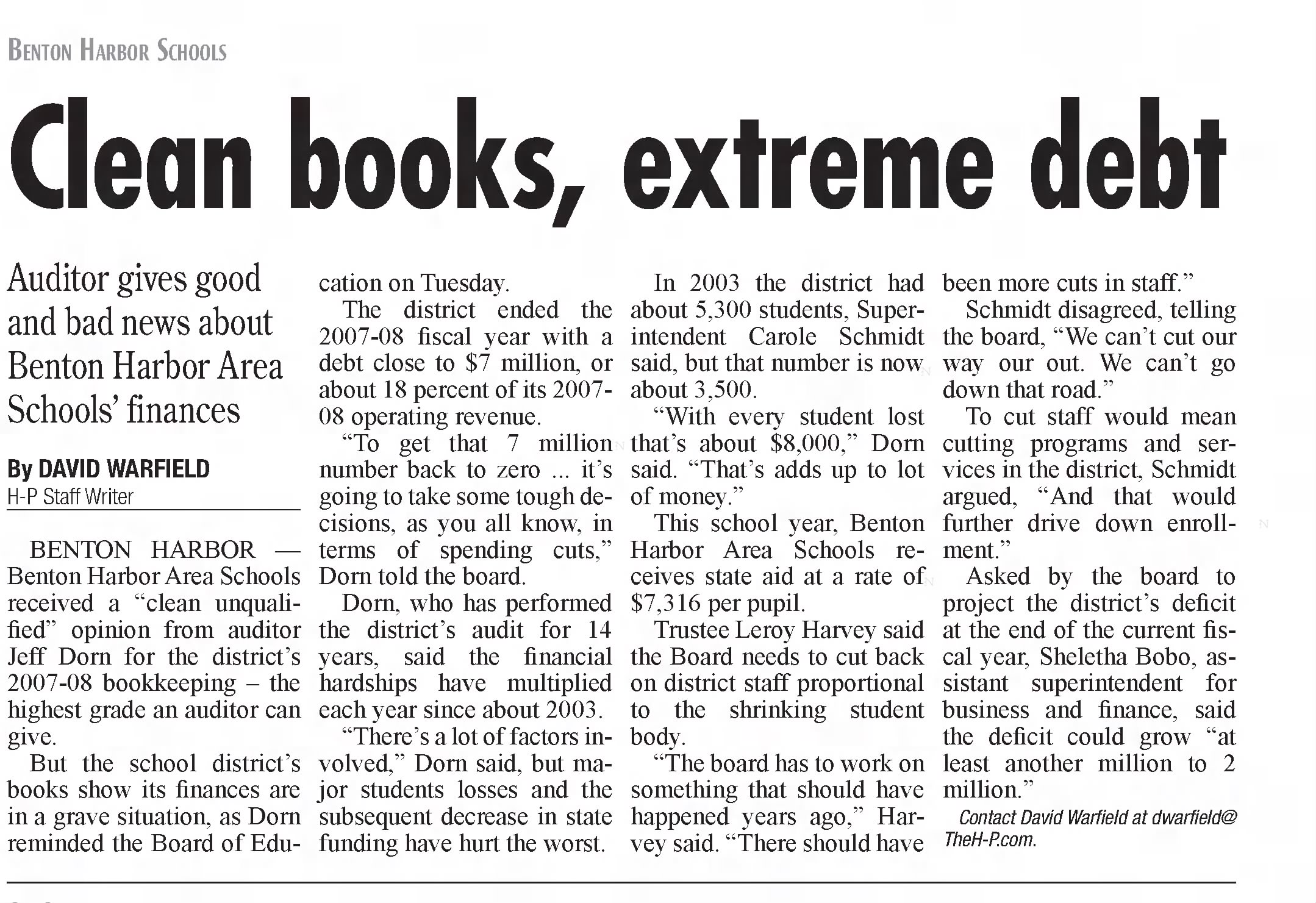
In the 2010-11 school year the district was seeking to cut $2.5 million from the budget. The district had an accumulated budget deficit of $11.5 million. The district offered buy out offers of $10,000 to teachers with at last 20 accepting.
In the 2011-12 school year the accumulated budget deficit had grown to over $18 million and the district was looking at layoffs, pay cuts, and consolidation. The teachers union took a temporary 10% pay cut. State Superintendent Mike Flanagan called the BHAS financial situation “critical and alarming”.
2012 – 2015: Emergency Loans:
Between 2012 and 2015 Benton Harbor took out a total of 4 emergency loans from the state of Michigan totaling $10 Million. The district had been running successive deficits since 2007. In 2014 it was so bad that they were in danger of not making payroll. At the time the district had built up $14.7 million in accumulated deficits. Loans were taken out in September of 2012, December of 2013, July of 2015, and in June of 2016. With the June loan the previous loans were adjusted to give the district more time to enact reforms.
The school district entered into a consent agreement with the state giving the district 2 years to show substantial improvement.
2016-2018: On A Good Path?
2016-17: Superintendent Shelly Walker Presented a plan to cut $2.5 million. Walker stated “A structural deficit of $2.5 million will not be fixed by buying fewer supplies or driving buses less miles. There will need to be a reduction of current staff if Benton Harbor Schools will remain open and operating.”
The 2016-17 adopted budget had 31 million in revenues with 28.2 million in expenses. From the Financial Health Status Report filed in 2020 for 2016 the actuals were $30,804,615 in revenue and $27,727,160 in spending, producing what looks like a $3,077,455 surplus… BUT: This surplus is due to the emergency loans that the district took from the state, that added to the long term debt. This shows up as “Other financing sources” in the revenue column. Discounting this, for 2016-17 the district had a roughly $1.8 million deficit.
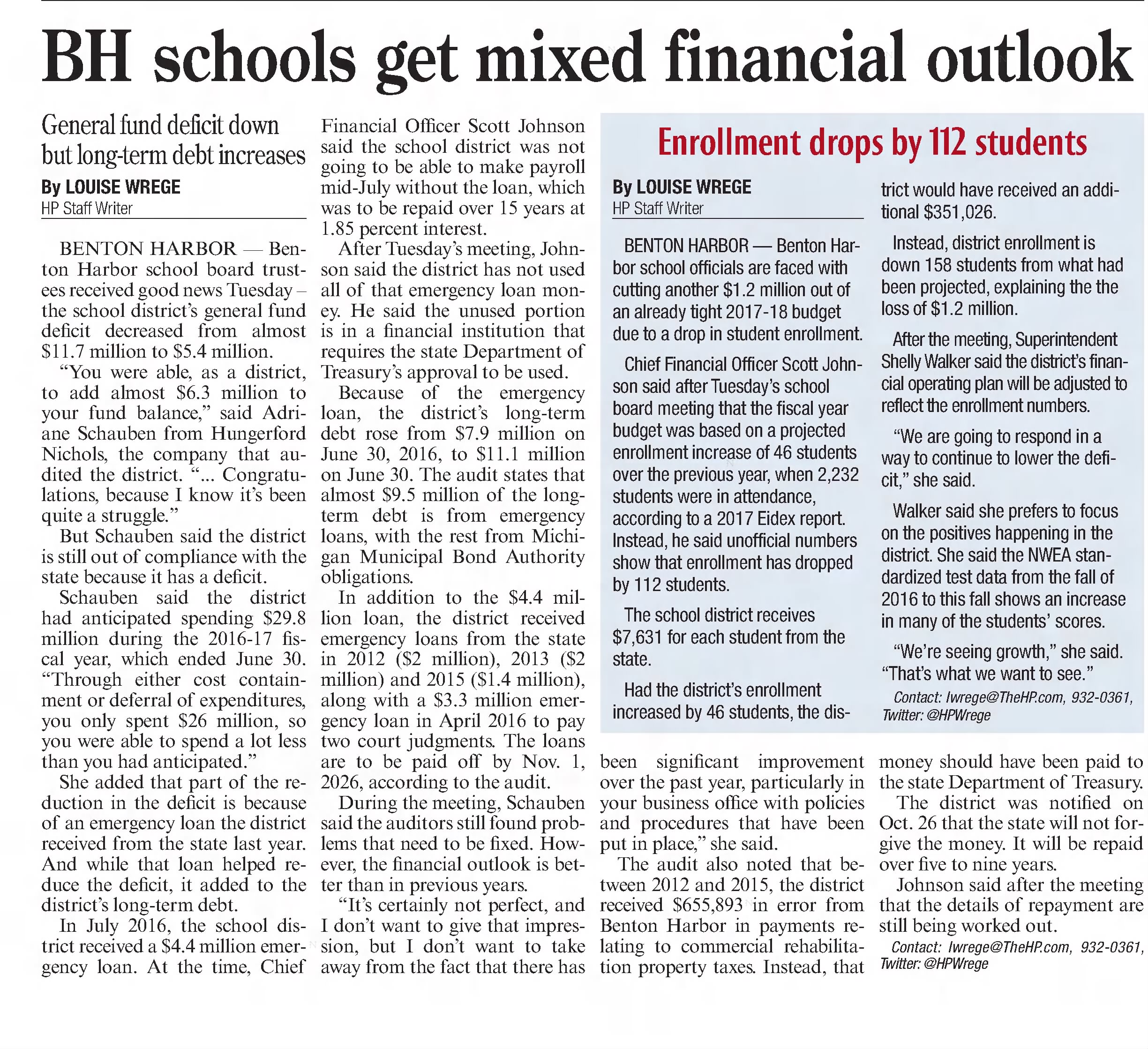
2017-18: Actuals show $32,324,668 for revenue and $26,062,996 for expenses, creating a $6,261,672 surplus. Accounting for the emergency loans under Other financing sources, the district still had a surplus of around $2.8 million. This is the only substantial surplus year in the last 25 years that is not from the Federal or State bail outs.
Superintendent Shelly Walker resigned in April of 2018 after being placed on “non disciplinary paid administrative leave” in February. Later in the year the Herald Palladium published this article:
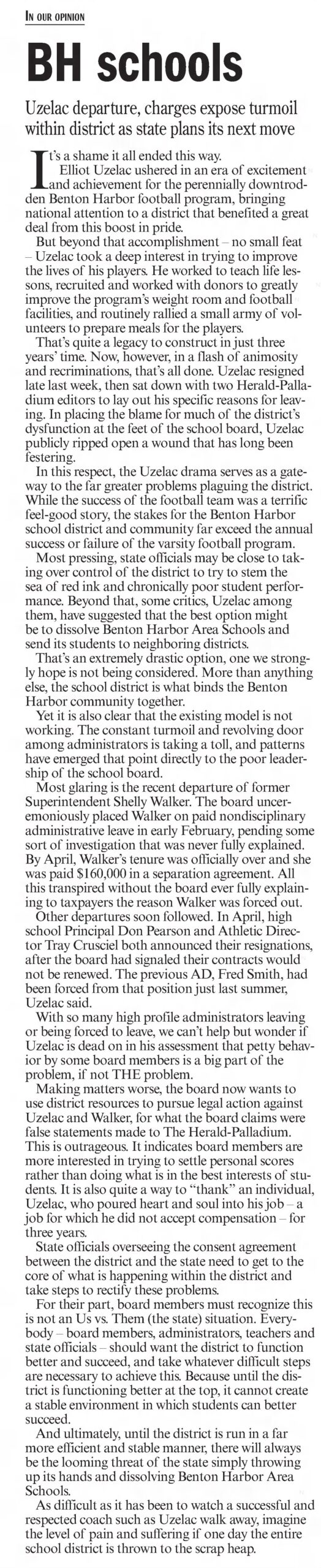
2018-19: In May of 2018 the school board approved closing the Dream Academy at the end of the 2017/18 school year to cut $1.3 million from its spending Actuals show $27,846,973 in revenue and $26,858,715 in spending. with a surplus of 988,258. This was a substantial drop in the surplus from the previous year.
2019 Plan To Close High School:
Governor Whitmer proposes closing Benton Harbor High School due to its $18 million+ of debt and deficit budget. Under a 2013 law a school district can be dissolved by just the state Treasurer and the Superintendent of Public Instruction if it meets 6 criteria from bridgemi.com:
A district must meet six factors to the satisfaction of the treasurer and state superintendent before the 2013 law can be invoked. Benton Harbor’s struggles likely meet five of those factors: it’s made poor progress in eliminating debt; its debt is growing; a case can be made it is not financially viable, it has student enrollment between 300 and 2,400 and hasn’t consolidated with another district.
But Zach Pohl, communications director for Whitmer, noted in an email to Bridge that Benton Harbor does not meet a sixth factor: a 10-percent decline in enrollment in its most recent school year. Benton Harbor’s enrollment dropped 9.3 percent from 2017-18 to the current school year. “
Rather than going this route Whitmer offered the proposal to keep the district, but only for K-8 and sending high school students to other area high schools. Eventually a plan was made with great pushback from the city to keep the district intact. Shortly after this Covid happened in March of 2020. Here is a scathing article about the management of BHAS during this time period.
2021 Federal Bailout: According to Michiganpublic.org, Benton Harbor Area Schools was to receive $94 million in COVID relief funds over three years, published in Nov of 2021. This massive increase of Federal money is what created multiple years of balanced budgets and established a large general fund balance. The audited financial statements from 2021 – 2024 show $68.5 million from the federal government hitting the general fund. There may have been more federal dollars that went to the school in other ways I have not found. The district was celebrated for being out of a deficit for the first time in 14 years.
2023 State Debt Transfer: State of Michigan $12 Million Debt Transfer: The state of Michigan in 2023 “forgave” Benton Harbor Schools debt from emergency loans it took from the state. At the time the principal balance was $10.3 Million and interest due was $1.76 Million. All transferred to State of Michigan taxpayers as a whole. This debt was scheduled to be repaid with yearly payments between $500,000 to $600,000 through 2045.
This was a really strange step for the State to take, given the same Whitmer administration just 4 years earlier had sought to shut down the high school and possibly the entire district. This is unfortunately too common in government: That which is not prohibited must be mandated. That which is not seized must be subsidized.
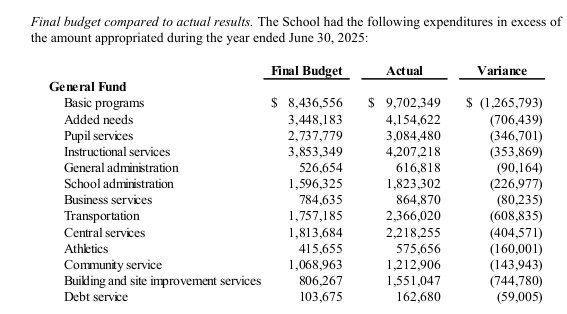
2025 Onward: The current budget for the 2025-26 school year shows a $7.4 million deficit. The primary change here is that the Federal government is no longer pumping massive amounts of cash to the school district. An addition problem is that Benton Harbor has recently underestimated its expenses in these budgets. For example in 2024-25 year the final budget was off actual spending by over $5 million. If that trend continues for 2025-26 rather than a $7.4 million shortfall the school district is looking at a $12.4 million shortfall. It will be interesting to see what the actuals come back at. I am hopeful the district will be able to turn this around and reduce the deficit throughout the year.
Revolving Door Leadership:
The Superintendent of Benton Harbor schools has been a revolving door position. In the past 25 years BHAS has had 11 Superintendents. During the same time period Coloma Schools had 4. To make matters worse, one of the longest running of those left for his next gig at the Berrien County Jail for embezzlement. Leonard Seawood, Superintendent from July 2010 to April 2015 was sentenced to 90 days in jail and $50,000 in restitution for embezzlement from the school.
| 2000 | Renee Williams |
| 2001 | Renee Williams |
| 2002 | Paula Dawning |
| 2003 | Paula Dawning |
| 2004 | Paula Dawning |
| 2005 | Paula Dawning |
| 2006 | Paula Dawning |
| 2007 | Carole Schmidt |
| 2008 | Carole Schmidt |
| 2009 | Carole Schmidt |
| 2010 | Leonard Seawood |
| 2011 | Leonard Seawood |
| 2012 | Leonard Seawood |
| 2013 | Leonard Seawood |
| 2014 | Leonard Seawood |
| 2015 | Greg Weatherspoon |
| 2016 | Shelly Walker |
| 2017 | Shelly Walker |
| 2018 | Bob Herrera (/CEO a new position created by the State) |
| 2019 | Patricia Robinson |
| 2020 | Andre Townsel |
| 2021 | Andre Townsel |
| 2022 | Kelvin Butts |
| 2023 | Kelvin Butts |
| 2024 | Kelvin Butts |
| 2025 | Simone Griffin |
School Performance:
For the 2024/2025 school year:
High School: (9-12)
- Percent of students proficient in all subjects on state test: <5% (Compare to 40% MI average)
- Percent of students making progress towards proficiency in all subjects: <5% (Compete to 46% state average)
- Graduation rate: 64% Vs. 83% state average
- On Track Attendance: 16% Vs. 71% State average
- Avg attendance: 71% Vs 91% State average
- Expenditures per pupil: $22,825 Vs $15,310 state average
- Suspensions/Expulsions: 222 Vs 27 state average
Fair Plain Middle School: (6-8)
- Percent of students proficient in all subjects on state test: 8% (Compare to 40% MI average)
- Percent of students making progress towards proficiency in all subjects: 15% (Compare to 46% state average)
- On Track Attendance: 33% Vs. 71% State average
- Avg attendance: 82% Vs 91% State average
- Expenditures per pupil: $25,331 Vs $15,310 state average
- Suspensions/Expulsions: 100 Vs 27 state average
Fair Plain Elementary: (4-5)
- Percent of students proficient in all subjects on state test: 9% (Compare to 40% MI average)
- Percent of students making progress towards proficiency in all subjects: 30% (Compare to 46% state average)
- On Track Attendance: 63% Vs. 71% State average
- Avg attendance: 91% Vs 91% State average
- Expenditures per pupil: $26,737 Vs $15,310 state average
- Suspensions/Expulsions: 14 Vs 27 state average
MLK Elementary: (1-3)
- Percent of students proficient in all subjects on state test: 7% (Compare to 40% MI average)
- On Track Attendance: 44% Vs. 71% State average
- Avg attendance: 86% Vs 91% State average
- Expenditures per pupil: $25,777 Vs $15,310 state average
- Suspensions/Expulsions: 35 Vs 27 state average
These stats are not new. Benton Harbor has been a chronically underperforming school for many years.
Here is the High School’s ranking between 2006 and 2018 compared to the state as a whole.
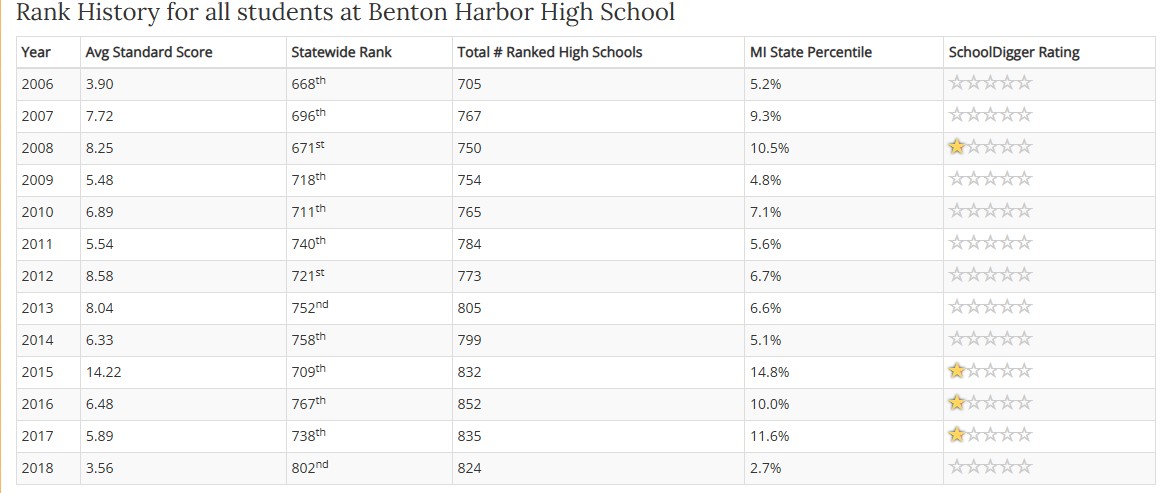
https://www.schooldigger.com/go/MI/schools/0483004162/school.aspx
Financial Improvement?
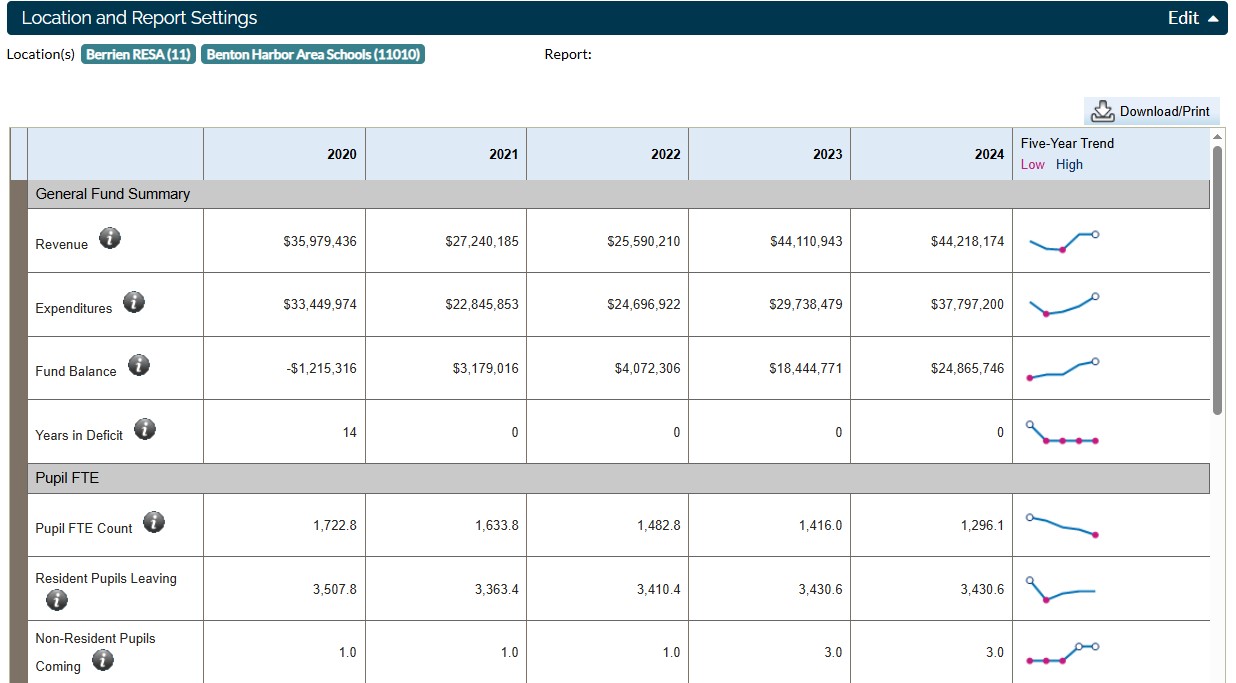
If you look at the chart it shows that Benton Harbor’s fund balance has increased from -$1.2 Million to $24.8 Million over the last 5 years. This shows great fiscal discipline right? Well no. The State of Michigan and the Federal government handed Benton Harbor Schools dump trucks full of money during Covid, including $10 Million of debt forgiveness transfer from the State of Michigan. Those large pay days are over and the fake surpluses are gone.
In 2025-26 the district has revenue of $24.5 Million and Expenditures of $31.9 Million. A large part of this drop is the Feds “only” giving Benton Harbor $5.5 Million this year. In the 2023-24 school year the Feds gave Benton Harbor $21.5 Million.
For the 2025-2026 School year Benton Harbor is running a deficit of $7.4 million. At this burn rate the current $24.8 Million fund balance will be depleted by the end of 2028. Will the state or federal government bail the school district out again? Once again, this is IF they stick to the final budget, which was under by over $5 million last year.
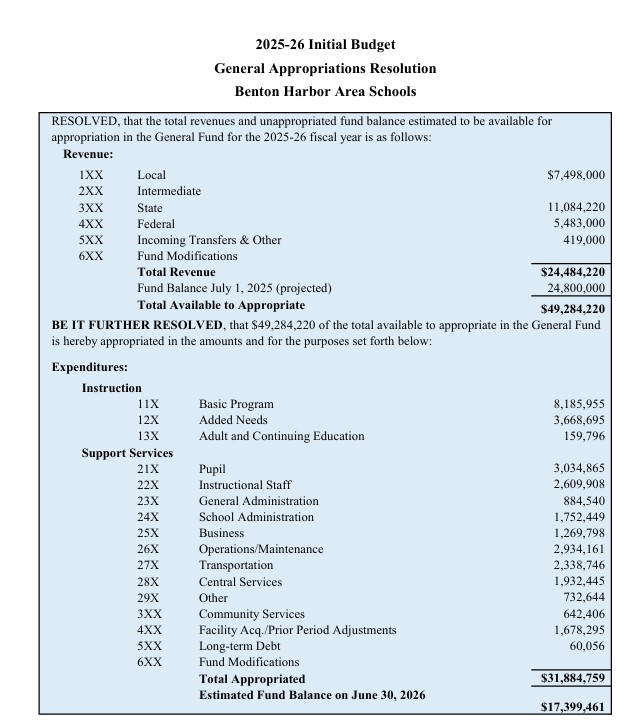
This is the sky is falling level of financial problems. A $7.4 million deficit is massive, especially for a district of this size. They are losing $5,710 per student.
Unused Assets:
I own several rental properties and if I have 1 vacant I spend all my energy working towards getting it back online so it is producing revenue. Not only do I want my assets producing revenue, but buildings sitting vacant depreciate fast. If no one is in them then issues are not found quickly to be repaired. If no one is in them windows start getting broken and other vandalism occurs. Pipes burst and no one notices. Roofs leak and no one notices. vermin get in. An asset’s value can easily be cut in half with a year of neglect. Many of Benton Harbor’s buildings have been sitting vacant for over a decade.
The Benton Harbor Area School District owns more vacant school buildings than buildings in use. Not only that, but the utilization rate of the buildings in use is extremely low.
In Use:
- Discovery Enrichment (PreK/K) 89 students (E Britain and S. McCord)
- MLK (1 to 3) 229 students ( E Britain and College)
- Fairplain East: (4 and 5) 150 students (Union and Starlight)
- Fairplain Middle (6 to 8) 240 students (Colfax and Napier)
- Benton Harbor High School (9-12) 469 Students (Colfax and Empire)
- Career and Alt Pathway 60 students (Pipestone and Catalpa)
Not In Use:
- Martindale Elementary: 2199 Laurel Ave (Scheduled for Demo) Last Used 2007
- Fairplain Northeast: 400 Donald Atkins : Last used 2009
- Fairplain Northwest Learning Academy: 1452 Learning Lane Last Used 2011
- Northshore School: 1690 N M63 Last used 2011(Was listed for $195,000 in 2017)
- Boynton School: 535 S. Crystal: Last used 2012 (was listed for $125,000 in 2017)
- Bard School: 1200 E. Main St (Scheduled for Demo) Last Used 2012
- Fairplain West: Fairplain and Hoover: 1901 Fairplain Ave Last Used 2014
- Sorter School 1421 Pipestone: Last used 2015
- Morton School: 520 Territorial Rd: Last Used 2016
- International Academy at Hull: Territorial Rd. Last Used after 2020
- 136 Acres of land Hillandale Rd / S Blue Creek
- AND A former Chemical Bank at 823 Riverview Drive. This building is on 3 acres overlooking the St. Joseph River. This is a 3 story 22,000 square foot building that BHAS acquired in 2009. The building was sold at a reduced price by Chemical bank and used as an administration building for a few years. Note: It was listed for sale in 2012.
- (Check out The Decay of Benton Harbor Area Schools Vacant Buildings; An Image Gallery)
Benton Harbor Schools has decided to demolish 2 of its currently vacant former school buildings, Martindale School at 2199 Laurel Ave and Bard School at 1200 E Main St. Bard was last used by the district in 2000 and was leased to the Boys and Girls Club from 2001 to 2012. It has sat vacant for the past 14 years. The district is paying $298,000 to demolish it.
Martindale School was closed in 2007 and has sat vacant for 19 years. The district is paying $228,000 to demolish it.
I would like to see a mechanism where if a building isn’t used after a certain amount of time the district automatically lists it for sale, maybe 2 or 3 years. These buildings were likely valued north of $1 million each when classes stopped occurring in them. Now they are worth roughly -$250,000 each.
(As a side note if the school district does decide to sell buildings, I will be a potential buyer for at least one of them)
Underutilized Facilities:
Of the 5 primary buildings being used, they are all underutilized for their design and further consolidation should be possible. In a 2020 Plante Moran report (Part 1 and Part 2) the #1 priority was to right size the facility footprint down from 600,000 square feet to 250,000 to 350,000 square feet based on the current enrollment of 1,750 students. With enrollment now down to 1,296 students, this would be closer to 185,000 to 259,000. I’m sure it costs a lot of money to maintain, light, and heat all this extra square footage.
After this study they did shut down some schools including the International Academy at Hull (53,400 sq ft) Currently the instructional buildings cover roughly 389,695 sq ft.
Discovery: (former Seely-McCord): 14 classrooms 38,350 sq ft:
Originally the building housed 140 kindergarten students and 300 children in head start programs when it was reopened as the Discovery Enrichment Center in 2011.
In 2019 it had 138 Kindergarten students and 64 PreK/GSRP students.
This one is difficult to find out its usage rate because Mischooldata does not provide easy to read information for PreK students. The only numbers we have are the original 140 Kindergarten students vs the current 80 kindergarten students, a 43% reduction.
MLK: 23 classrooms: 52,150 sq ft:
In 1999 when King Jr High was turned into MLK, the plan was for up to 475 students from K-5 grade to be in the school. This is a rate of just over 20 students per classroom. The current enrollment is at 48% of this.
Fair Plain East: 17 classrooms 28,000 sq feet:
Using 20 students per classroom the capacity is 340 students. Now with 150 students would be 44% occupied.
Fair Plain West/ Fair Plain Middle School: 21 classrooms 51,645 sq ft:
240 students. Using the same 20 students per classroom metric as above this would be a capacity of 420 students. Currently there are 240 students for an occupancy rate of 57%.
High School: 46 classrooms 219,550 square feet:
While the district has played musical chairs with the other buildings in the district the high school has stayed the high school. The high school building at 870 Colfax was originally built in 1921 and was expanded over time. At an occupancy of 20 students per classroom the capacity here is 920 students. Currently there are 469 students for 51% occupied. The true occupancy is likely lower than this here. In elementary school students have the same classroom all day, but in high school they switch classes throughout the day. With gym class once a day we get a 16.6% increase in student count available to 1,072. High schools often have a higher number of students per classroom. Adding 5 more students per classroom adds another 200+ students.
Historically the district fit more kids in the building. In 1971 grades 9-12 had 2,588 students, which was 135 less than the previous year. In a 1964 article on the consolidation that formed the Benton Harbor Area School district it is stated that the high school has a capacity of 2,000 students. In the 2002-03 school year Benton Harbor High School had a student count of 1,281, this is greater than the entire student count of the district.
In 1966 5 English classes were taught at a nearby church due to the Colfax campus being at max capacity.
With all of this being said the high school is actually much closer to a 25% utilization rate than a 50% utilization rate. There should be tons of available space.
CAPE: The CAPE Career and Alternative Pathways to Education Center building has roughly 6,200 square feet. This isn’t a large building, but there is little doubt that they could be transferred to the high school.
What can be done?
When the state was evaluating shutting down the high school due to the district’s financial situation the community strongly opposed it. Keeping that in mind, if we keep the high school then we should be transferring students from lower grades to the high school building. At a minimum 2 school buildings could be consolidated.
Fair Plain Middle school would merge to the High School, so grades 6-12 would be in the same building. This would increase the student count at the high school to 709 students. Fair Plain Middle would immediately be listed for sale. The building has the most value directly after being vacated.
Fair Plain East School consolidates into MLK. This would put MLK at 379 students, still almost 100 under its original planned headcount. Sell the property immediately.
Eliminated these 2 school buildings would reduce the building operational costs and likely busing costs as well, since Benton Harbor would be down to only 2 campuses since the Discovery Enrichment center is adjacent to MLK.
While the sale of the buildings helps build up the general fund, or at least slow its depletion, the main focus is to reduce operational costs. This is 80,000 square feet that doesn’t need to be heated, lit, maintained, or driven to. It eliminates duplicate positions, reducing non-instructor headcount.
Fixing a $7.4 Million budget hole is difficult, and nearly impossible without extremely fast action. From a recent school board meeting where they decided to pay kids to show up to school it was clear that the board was not viewing the current financial situation as dire.
I will give credit to President Dashuna Robinson who stated in June 2025 at the passing of the budget:
“However, I am voting ‘no’ because I cannot stomach the negative $7.4 million balance,” Robinson said. “While I know that it’s a requirement, I am not comfortable at this particular time with approving a budget with over-projected spending.”
Benton Harbor is spending $1.1 Million on virtual teachers in a contract with Proximity Learning. They then have a “facilitator” in the classroom. This is to cover 18 teaching vacancies. The concept of virtual teachers is interesting.
Benton Harbor Number of Employees:
For the 2023/2024 school year Benton Harbor had 455 total staff, with 350 staff full time equivalent (FTE). This number represents a better employee number due to turnover and part time positions. The district had:
- 20 administrators
- 114 teachers
- 28 Parapros
- 188 non instructional staff
This gives a non instructional staff percentage of 53.8%, which is by far the highest in the county. The next highest is Eau Claire at 42.3%. The average for the county is 34.4%.
If Benton Harbor had the same percentage of non instructional staff as the county average this would be 68 fewer employees just for non instructional staff. Benton Harbor had a student count of 1,292 in the 2023/24 school year. 350 employees is 1 employee for every 3.7 students.
For the 2024/25 school year Benton Harbor had 359 FTE employees.
- 22 Administrators
- 122 Teachers
- 34 Parapros
- 181 non instructional staff
With 1,228 students for 2024-25 this is 1 employee for every 3.4 students.
Comparisons:
Countryside Academy had 93 employees with 25.6% being non instructional staff. Countryside had 752 students, which would be 1 employee for every 8.08 students.
Coloma had 142 employees with 31.4% being non instructional. Coloma had 1,167 students, which would be 1 employee for every 8.21 students.
If Benton Harbor had a ratio of 1 employee per 8 students, they would have 161 total employees. Adjusting for the 2024/25 school year enrollment number of 1,241 students they would have 155 total employees, Almost a third of their current staff.
Reducing headcount by 195 people at a median total compensation of $70,000 each (includes retirement, health insurance, workers comp, etc.) Would be $13.65 million per year in savings.
Benton Harbor doesn’t need to go this deep. They could go half way and likely fully eliminate the deficit, but they won’t because even getting halfway to the staff/student efficiency of competing districts would be seen as too drastic of a cut. The school system is a large bureaucracy and bureaucracies protect themselves. Recently they evaluated eliminated 30 positions to address the budget, but this was met with pushback as some board members believe that cutting staff when the district “has money” is the wrong thing to do. Closer to 100 spots, not 30, need to be cut before the start of the 2026-27 school year, and it will likely not happen.
Looking at this the opposite way, Benton Harbor is staffed as if it has 2,872 students. It has been 15 years since the student count was this high.
Charter Schools In Benton Harbor
Charter schools give an alternative option for parents. Charter schools do not receive any property tax money or money from taxpayers to build or maintain schools. They only receive the state per pupil funding. They also do not receive tens of millions of dollars in state or federal bailouts.
Countryside Charter:
Countryside Charter school opened in 1997 with under 200 students as a K-8 school in modular buildings on farmland. Countryside is located at the far East border of the Benton Harbor school district on rural land. Each year they added an additional grade until they had a full high school program. This allowed all the kids who started Countryside to be able to finish high school there and gave steady predictable growth based on a new Kindergarten class each year. By 1999 they were offering a Young 5s program. In 2018 Countryside reached 750 students. Countryside recently completed a $9,000,000 37,000 square foot elementary school.
Mildred C Wells: The Mildred C Wells Academy opened in 2005-06 and currently serves K-8 with student enrollment of 227. The school has maintained an enrollment in the mid 200s for most of its history. It is based in a 16,000 square foot building on 9th st. in Benton Harbor.
The Bridge Academy: Note: The Bridge Academy became a charter school in 2021 that serves only grades 9-12, with 112 current students. In 2021 they only had 72 students. The Bridge Academy provides an alternative spot to BHAS for students entering 9th grade who have aged out of Mildred C Wells or Benton Harbor Charter. Prior to being a charter school the Bridge Academy was founded in 2010 as a partnership between Michigan Works! and multiple area school districts to reduce the drop out rate in the area.
Benton Harbor Charter:
Benton Harbor Charter school began as a K-5 school in the 1999-00 school year. It is located in the old K-Mart building on Riverside drive which has roughly 80,000 square feet of space. In 2001 they had grown to a K-6 school. then principal Earl Williams discussed the school eventually becoming a preK through 12th grade school, and to also include adult education classes. For most of Benton Charter’s existence it has had roughly 450 students. By 2004 the school was K-8 and they had a young 5s program starting in 2010.
Benton Harbor Charter currently still serves students up to 8th grade. Over the years they have entertained the idea of offering 9-12, but have never gone in that direction.
For the 2023/2024 school year, Benton Harbor averaged 83 students per grade for 4th – 8th, yet averaged 126 per grade for high school. This is a gain of 43 students in 9th-12 grade on average. This lines up perfectly with the likely number of students leaving Benton Charter Schools. Benton Harbor Charter has 418 students, across 9 grades is 46 students per grade. Each year 43 students graduate out of 8th grade at Benton Charter and must go somewhere. Countryside doesn’t have the openings, and school of choice openings for 9-12 slots are rare. Most of these students end up at Benton Harbor for high school. (BHAS also has the opportunity to gain HS students from the Sodus and Hagar districts which are K-8)
Now, what happens if starting next year Benton Charter offers 9th grade and adds a grade each year until they have 9th through 12th? Or if Countryside added 2 classes to each high school grade for 4 years to accommodate a permanent agreement to educate the kids who graduate 8th grade from Benton Harbor Charter? Or if The Bridge Academy expands to an official partnership with Mildred C Wells and Benton Charter?
BH enrollment could lose 43 students per year just from that attrition for 4 years, in addition to the natural attrition that the school district has of an average of 8% per year.
- 2025-2026: Start at 1237 decline by 8% to 1,138 official count
- 2026-27: Start 1,138 decline by 8% to 1,047. Lose 43 students not transferring to 9th grade = 1004
- 2027-28: Start 1004 decline by 8% to 923. Lose 43 students not transferring to 9th grade = 880
- 2028-29: Start at 880 decline by 8% to 810. Lose 43 students not transferring to 9th grade = 767
- 2029-30: Start at 767 decline by 8% to 706. Lose 43 students not transferring to 9th grade = 663.
In just 5 years the student count would reach 663 with Benton Harbor Area Schools educating less than 15% of the kids in the district. Even without Benton Charter solving for high school just the 8% drop would still put Benton Harbor at under 900 students by 2030.
But WAIT, it gets worse!
The downward trend in Benton Harbor Area Schools students will likely continue based on grade data. Look at this by grade:
| 2021 | 2022 | 2023 | 2024 | |
| K | 101 | 100 | 86 | 80 |
| 1 | 87 | 101 | 79 | 72 |
| 2 | 97 | 85 | 81 | 77 |
| 3 | 107 | 104 | 76 | 81 |
| 4 | 88 | 94 | 76 | 70 |
| 5 | 112 | 78 | 94 | 80 |
| 6 | 107 | 94 | 72 | 83 |
| 7 | 116 | 89 | 90 | 75 |
| 8 | 123 | 112 | 94 | 94 |
| 9 | 151 | 158 | 143 | 120 |
| 10 | 138 | 147 | 147 | 130 |
| 11 | 134 | 140 | 120 | 140 |
| 12 | 134 | 122 | 134 | 126 |
| Total | 1495 | 1424 | 1292 | 1228 |
Up until the 2021 Benton Harbor had a strategic advantage of being the only school with a preschool program. This gave them essentially first dibs on children. By getting the kids for Pre-K (age 4) they had an advantage to retain them for Young 5s-12.
In 2021 Benton Harbor Charter began offering a free PreK program for 3 year olds with automatic enrollment into their 4 year old GSRP program. This shows up in the Kindergarten enrollment changes for Benton Harbor Area Schools in 2023 and 2024.
At the start of the 2024-25 school year Countryside also began a Pre-K program in their new building for 4 year olds. Between Countryside and Benton Harbor Charter Benton Harbor is seeing a major decline in their Kindergarten numbers. The effect of the Countryside 4 year old program will show up in the 2026-27 school year numbers when the first children in the program enter Kindergarten. Add this to the already discussed drop in population and fertility rate and the numbers get really difficult. I would not be surprised if for the 2026-27 school year Benton Harbor Kindergarten enrollment dropped below 60 students. Countryside has 2 classrooms for the 4 year old GSRP program with a state limit of 20 students per classroom.
Benton Harbor reported 80 kindergarten students in 2024, down from 100 just 2 years earlier. This is a 20% drop, compared to the 15% drop the district as a whole saw in this time period. With the exception of a bump at 9th grade since Benton Harbor Charter is only through 8th grade, the trend each year is downward for each grade.
Of the 100 kids in Kindergarten in 2022 only 77 were 2nd graders in 2024. Of the 85 2nd graders in 2022 only 70 were 4th graders in 2024. Enrollment numbers, especially for Benton Harbor, typically do not increase with the class as they age. This means that the limiting factor is starting with the kids in Kindergarten.
Due to this drop the total enrollment will drop faster than it historically has. This is something to keep an eye on especially once the 2025 and 2026 school year enrollment numbers are published.
A plus for Benton Harbor is that at this point the student count doesn’t matter as much as it used to. The school district still receives 100% of the property tax money for the district regardless of how many children it educates. The current budget shows $7.5 million for local property tax revenue which is about the same as it received in 2010, but in 2010 the district had 50% more children. As the district shrinks it effectively receives more money per child due to the steady property tax money.
Update 2/20/25: Since publishing this the 2025-26 Enrollment numbers have come out. The good news for BHAS? Grades 1-8 in general saw an increase in enrollment compared to the size of the class the year prior. (comparing 1st graders this year to Kindergarteners last year). This group had a net gain of 37 students. The most impressive was 6th and 7th grade with gains of 10 and 11 students respectively. First grade was also really impressive with a gain of 9 from the previous years Kindergarten.
The bad? Kindergarten dropped 14 kids from 80 to 66. 10th grade had a drop of 20 students and 11th grade had a drop of 18 students.
The Trajectory:
I know this has been a long essay but the alarm must be sounded.
With steady $7.5 million deficits the general fund will be exhausted on October 30th 2028. At this point the district will be spending $625,000 per month that it does not have, building up the negative general fund balance.
The most likely situation is that the actual deficit will be closer to $12 million per year and the general fund will be exhausted by July 30 2027.
Both of these scenarios are extremely bad. Both of these scenarios lead to the same place only 18 months apart. The district will be in the territory where it can be dissolved by the state of Michigan, because all of these factors will be true:
- The debt is growing
- It has made poor progress in eliminating its debt
- A case can be made it is not financially viable
- It has student enrollment between 300 and 2400
- It has not consolidated with another district
- A 10 percent decline in enrollment in its most recent school year
Once the current general fund surplus is spent, bullet points 1-3 will all be met simultaneously in the following school year. Point 4 is already made due to size and Point 5 is already made as there is no scenario where a nearby district would consider consolidating with Benton Harbor. This means that once the fund is empty in addition to the fiscal problem of literally not having any money, the district will be in a single point vulnerability position where a single year of a 10% reduction will end the district. Benton Harbor last had a 10% reduction in 2023, before that it was 2015.
If Benton Harbor Area Schools is to survive it must shed a minimum of 100 positions immediately and take aggressive action to divest from non revenue generating real estate. The 2021 Federal bailout was an amazing gift that the district is poised to burn through in just a few short years.
I do not want Benton Harbor Area Schools to fail because many will view it as a failure of the community as a whole. I think that there can be potential in the school if it could turn around student outcomes, but that has not been the trend. The space Benton Harbor has available at the High School lends itself well to career training programs. This could become the draw to bring students back because they want to do the new electrician program or mechanic program at BHAS.
What did I miss? What actions do you think can save BHAS?
Leave a Reply