
Can Benton Harbor Area Schools Avoid Mass Layoffs?
Over the last month I have been analyzing the situation at Benton Harbor Area Schools (and Benton Harbor Charter). Benton Harbor Area Schools (BHAS) has received substantial State and Federal aid over the last 5 years which is now drying up, leading to a budget deficit of $7.4 million from the initial budget for the 2025-26 school year. BHAS has also continued to struggle with declining enrollment. Some board members are looking for a plan to right size the district, while others are 100% against any layoffs. Without either substantially increasing revenue or substantially cutting spending, BHAS will run out of its current general fund balance in roughly 3 years, putting the district into a deficit situation. This will then put the State of Michigan in the drivers seat and bring us back to the possibility of a state takeover or the district being shut down entirely. What can be done to stop this and save the district?
The Summary of the Situation:
From the initial budget for 2025-26 BHAS is running a $7.4 million deficit. BHAS will make an amended budget next month to update their forecast, which will likely see this increasing, as through several meetings additional expenses have been discussed and authorized. In the last year’s audit the school district spend over $5 million than what the amended budget allocated. The district as of 2024-25 had 349 FTE (full time equivalent) employees. The FTE number adjusts for part time employees and reductions and increases throughout the year. Those employees included:
- 22 Administrators
- 122 Teachers
- 34 Parapros
- 181 non instructional staff
With a K-12 student count of 1,228 students this is 1 employee for every 3.4 students. Compared to Countryside Academy, which has 770 students and 116 total FTE staff consisting of
- 6 Administrators
- 58 Teachers
- 20 Parapros
- 32 Non Instructional staff
This is 1 employee for every 6.63 students. BHAS has almost twice the employees per student as Countryside.
Compared to Coloma Schools, Coloma has 143 FTE employees consisting of:
- 12 Administrators
- 76 Teachers
- 9 Parapros
- 46 Non Instructional staff
Coloma has 1,095 K-12 students for a ratio of 1 employee for every 7.66 students. BHAS has 225% more staff than Coloma on a per student basis.
The most obvious choice here is to reduce headcount substantially. This is what was being discussed at the most recent school board meeting, about developing a path to rightsizing the district. If the average employee has total compensation of $75,000 then reducing the employee count by 100 would effectively eliminate the current budget shortfall. This would result in the district having 249 FTE staff, or 1 employee for every 4.9 K-12 students. The district would still have far more employees than comparable schools, yet have a balanced budget.
The goal of this article is to explore ways the district can survive without immediately laying off 100+ employees.
Revenue Increases:
Board Treasurer Elnora Gavin stated that she wanted to look into creative ways to increase revenue rather than focus on a plan to “right size” the district which would include layoffs. Let’s explore this and see what we can do. I will also include ideas to save money that don’t necessarily include layoffs. Is it possible to save BHAS without layoffs? I hope so, let’s brainstorm. Please comment any ideas you have!
Selling Vacant Buildings and Land:
The first glaring revenue source is to sell off the vacant buildings and land BHAS owns, which combined should generate somewhere around $2 million in 1 time revenue (This is pricing the 100+ acre parcel of land at $1m and the average building at $100,000), plus a yearly savings on maintenance and utilities that should be in excess of $200,000 per year when estimating $20,000 average per building. I’ll personally buy at least 1 of them to help with the cause. There likely would be a substantial savings on insurance costs as well.
Increased Enrollment K-8:
For the 2025-26 school year BHAS has 1,203 total students. For the first time in many years BHAS has increased its student count in several elementary grades, most likely due to a 20% decline in enrollment at Benton Harbor Charter. This is not necessarily due to BHAS doing well, it is due to Benton Harbor Charter (BHC) failing.
The first option is to assist Benton Harbor Charter with its current death spiral. It is entirely possible that next school year could be the last for BHC due to its current deficit. If for 2026-27 BHC even loses half the students it lost this year there is a good chance they will cease to operate, meaning all of their remaining students will need somewhere to go, with BHAS being to most likely landing spot for most of them. This could result in a gain over the next 2 years of around 300 students. 300 students when accounting for both the foundation allowance and the Michigan at risk funding under 31a is $11,908 per student for $3,572,400 in additional revenue.
So how can Benton Harbor Area Schools help BHC speed up its destruction and attract current BHC students? Attract as many of their students as possible for the 2026-27 school year.
Highlight their weaknesses as your positives.
The bussing situation is a cause for many complaints for Benton Harbor Charter. Reaching out to the community touting bus route efficiencies, including on time stats and checks that are done to ensure all kids get to the correct destination.
Highlight that the discipline policy for K-8 does not relying on suspension unless due to a significant safety issue. Benton Charter had 176 suspensions/expulsions last year with 418 total students in K-8 (1 suspension for every 2.3 students), which is a cause for many parents to be frustrated with the school. (BHAS K-8 had 157 out of 712, or 1 suspension for every 4.5 students).
Follow up with parents who recently left BHC to come to BHAS and find out what positive aspects of BHAS they have discovered and what negatives they have encountered. These parents and students still talk to their friends who attend Benton Harbor Charter. Their experience this school year is the link to pulling in their friends next year.
After School programming: Rather than eliminating positions, change several into after school program leads. Advertise heavily that the school has after school programing that includes study hall and gym. The kids can stay as late as 530pm each day. The 1pm early release Fridays at BHC are hated by parents. Having the flexibility for kids to stay at school longer AND get more reading/math help or more exercise time would be highly desirable.
Increase Enrollment 9-12:
The next option is on the High School Side. Currently Benton Harbor Charter, Mildred C. Wells, Hagar, and Sodus all are only K-8 and most of their graduating class ends up coming to Benton Harbor High School. BHAS sees a large increase in 9th grade, then each year a large drop as those students either are able to go to another school or drop out entirely. Here are a few options to attack the 9-12 enrollment, but especially the 9th grade.
Benton Harbor effectively lost 57 high school students last year:
- Had 126 9th now have 106 10th – 20 students
- Had 100 10th now have 80 11th – 20 students
- Had 112 11th now have 95 12th – 17 students
- This attrition equals $678,756 in revenue.
Currently BHAS has 92 8th graders. The K-8 schools in the area have the following number of 8th graders:
- Benton Harbor Charter: 18
- Mildred C Wells: 19
- Hagar: 7
- Sodus: 5
These 49 8th graders represent an opportunity to pick up $583,492 in revenue. Upon implementing the below mentioned solutions opening up the high school to school of choice and advertising this heavily.
Option 1: Focus on Early Graduation:
Part of the problem with high school is it takes too long. Having a clear option for students to be able to graduate at an accelerated pace will draw back district students and draw in students from other districts. Several years ago Benton Harbor had an article about three girls who graduated early. BHAS and other area schools partner with Lake Michigan College for the Early College program, but that is only beneficial if the student plans to go to college. Graduating early provides the ability for the student to enter the workforce sooner. This has worked out very well for my son who graduated early through the Penn Foster program.
Alternatively partner with a program like Penn Foster High School to essentially offer their program to students with a physical presence here. The logistics would look something like this: BHAS enrolls the students and receives the state funding for the student. The student attends BHAS like normal, and in the classroom they perform the work in the Penn Foster online program. They have facilitators in the room who do not need to be teachers to assist the students with any struggles they have and those facilitators make progress reports for the students. Penn Foster is paid their normal fee of $1,100 per student by the school for use of their system. BHAS transfers the credits from Penn Foster when the program is done and adds in a few classes to round out the students. Students would also have lunch at school and participate in gym class, as well as having the opportunity to participate in school sports. This program would be set up at a structured pace where the students would graduate in three years instead of four. The structured school environment and ability to play sports takes away the negatives that come with programs like Penn Foster, but keeps the main draw, being able to graduate early.
From what I have been reading the CAPE center effectively provides a similar opportunity now, but it is not highlighted to the community. Having a Social Media campaign detailing how kids can graduate in 3 years would likely draw many students in district to BHAS and some out of district to BHAS.
In addition to highlighting that they can graduate early, advertise the WHY. The Why is so that the students can get employment while living at home so they can save up a down payment fund and invest in retirement accounts that will build wealth over time.
Option 2: Skilled Trades Training With Job Placement:
In addition to the regular high school programing having a skilled trades high school program that prepares students for real actual jobs that pay more than retail/food service when they exit high school.
Partner with Lake Michigan College for students to be able to take skilled certificate programs during their junior or senior year in high school. This gives an incentive to stay at BHAS. For half the school days the students attend LMC not through the current early college program to earn an Associates degree, but to earn skilled certificates such as: CNA, EMT, CDL, and welding. The 5 year high school program only works for students who plan to earn a 2 year degree, so we need some different options.
Having additional skilled trades programs in house where students can earn state recognized skilled trades certificates like ASE mechanic certifications.
Option 3: Expanded Drivers Ed Training:
With the current staff the district has some of those staff members could get certified to teach drivers ed. Include drivers ed in the curriculum so that if a student graduates from Benton Harbor High School, they have a drivers license. I read that last year BHAS was providing a drivers ed program with funding from a federal grant. Hopefully it has continued for 2026. Once again, ensuring the community knows about it makes a big difference. Making it seamless into the curriculum matters here as well.
Most of the cost of a drivers ed program is paying the instructors for the drive time. Transitioning some of Benton Harbors non instructional staff to Drivers Ed trainers will allow them to keep their jobs and reduce the cost of the program.
After ensuring that all BH high school students can participate in Drivers Ed, turn the program into a profit center and provide drivers ed training to the teens of Berrien County as a whole. Most places are charging around $500 for segment 1 and the classes fill up fast. Could the school throughout the year offer Segment 1 to 500 teens outside of Benton Harbor Students and bring in revenue of $250,000 a year?
Other Revenue Increases:
Space Rental: The school buildings are mostly vacant in the evenings and weekends. This provides the opportunity to rent out space for additional revenue. The high school has a large auditorium with seating for 1200 people. Could this be a rented out venue for performers who can’t afford the Mendel Center? In addition to collecting a venue fee, the school could also operate a concession stand during performances for additional revenue.
Could large meeting rooms be rented out on evenings or weekends?
Could the gym(s) in these schools be rented out for birthday parties? I know my kids would love to have full use of an indoor basketball court for just them and their friends for their birthday.
Could some vacant classrooms be rented out as office space during the school year? Have a wing of one of the schools that gets partitioned off as this rental space. Or even climate controlled storage. We are heating the buildings anyways.
While awaiting the sale of buildings could the parking lots at those schools be used to generate revenue by leasing on a service like “Truck Parking Club”? Or perhaps some RV and boat storage? Hull School would likely be the best option with its proximity to business loop 94 and being across from the police station.
Invest the current General Fund money in T bills: Short term T Bills offer a 3.6% return. 3.6% of $17.4 million (Projected fund balance end of the current year) is $626,400 per year in interest income. If this is not already a general practice it could be a decent source of additional revenue.
Headcount Reduction Without Layoffs:
Fire for low performance and don’t replace: In any organization the bottom 10% of people likely should not be employed and the bottom 5% certainly shouldn’t. In an organization with 350 people there are certainly 17 that should be fired for cause. These aren’t layoffs, but do help with the deficit. At an average total compensation of $75,000 each this is $1.275 million in savings per year, every year.
Offer Buyouts: The idea here is to offer people buyouts to leave. In general when firms do this they offer something like 2 weeks of pay per year of service, usually with a cap at 26 weeks total. This is a common practice in corporate America and in school districts throughout the country. BHAS in in a great position to do something like this right now. The district is running a substantial deficit, has twice the staff needed, and has large cash reserves for right now. These types of buyouts also tend to be most attractive to people who are at their higher earning years anyways and a large lump sum of cash gives them the final incentive to leave. The district can also put limits on the numbers of positions that could accept and it would be done on a first come first serve basis. Something like no more than 40 teachers, 60 non instructional staff, 10 parapros, and 8 administrators.
When St. Joseph Schools did a buyout program in 2012 they offered it to 80 total employees and 12 accepted. These were offered only to teachers at step 10 or above, and they were offered a flat 1 time payment of $20,000. I would suggest if going with a flat fee amount to make it a good one. Something like a 1 time payment of $40,000. Benton Harbor has short term cash reserves, it does not have long term sustainability from operations. If 20% of the district takes the deal, that would be 70 employees. At an average total compensation rate of $75,000 per year this would cost $2.8 million and free up $5.25 million per year every year in the future.
If the district fully implemented both of these the total employee count would be reduced by 87 people to 262 employees. for a student population of 1,228 is a staff ratio of 1:4.68, still far more generous than nearby districts. If the goal would be a ratio of 1:7 the school should still be able to handle all normal functions and have 87 employees available to move into other roles to reduce costs throughout the district, as discussed above and below.
Other Expense Reductions:
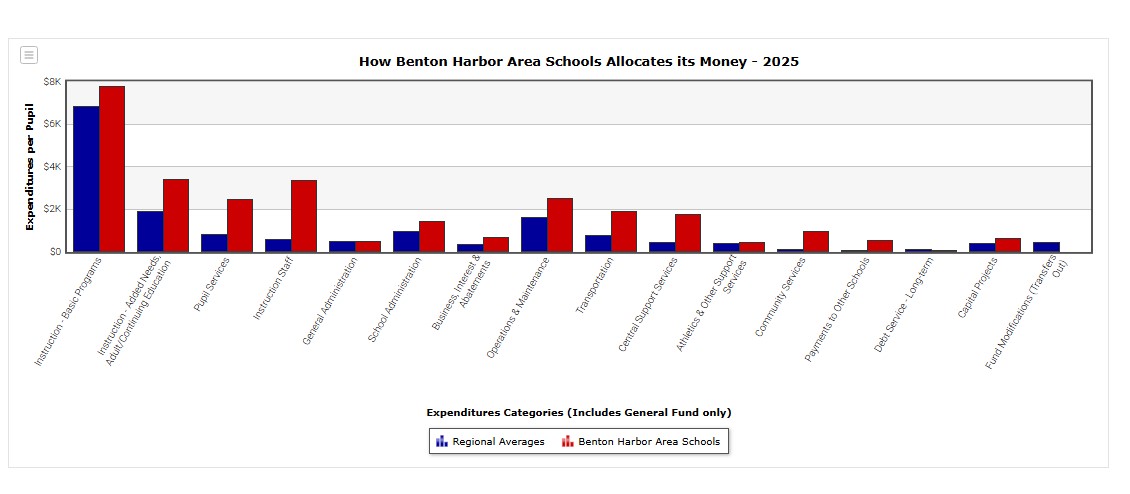
Here is a chart of BHAS spending vs. the regional average from their website. Note how the red bar is taller in almost every category.
Consolidating Remaining Buildings:
The next item would be to combine buildings to reduce operating costs. The CAPE center and Fairplain Jr. High could be moved into the High School and the Discovery Academy and Fairplain East could be moved into MLK. These four buildings recently vacated could be sold, likely combined bringing in 1 time revenue of over $800,000 and reducing operating costs by over $100,000 each on average per year not including positions that could be eliminated. Utilities, mowing, and insurance would likely be the 3 largest reductions in cost. The district paid $405,012 to Middle Cities Risk Management Trust. My assumption is this is the primary insurance for the district. If the district consolidated to only having 2 or 3 in use buildings and sold everything else then this would likely decrease quite a bit.
Reduced Compensation For Top Paid Employees:
In 2023 there were 4 employees in BHAS that had wages over $100,000 (The threshold for reporting). Those 4 positions included the Superintendent, 1 Principal, the Director of Literacy, and the Chief of Student Services. Average wages were $127,914.25. Average total compensation was $183,520.50.
For 2025 there were 11 employees with wages over $100,000. This included The Superintendent, The Director of Finance, the Director of Student Support Services, the SPED Director, 4 Principals, and 3 Teachers. The average wages were $111,339. Average total compensation was $176,606.64. Much of this is likely controlled by collective bargaining agreements.
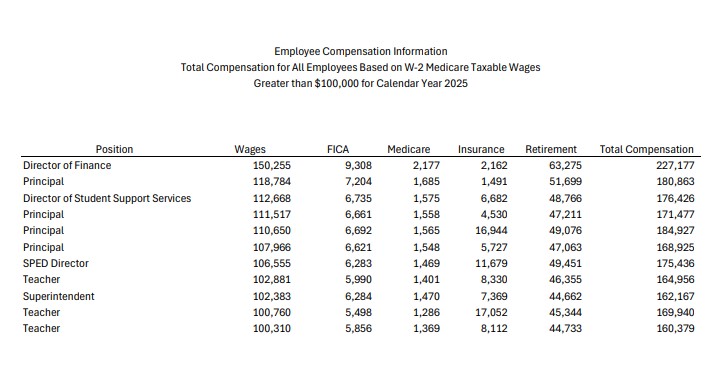
For comparison In 2024 (the most recent published), Coloma has 3 employees with compensation over $100,000. I’m blown away by how much money districts put into retirement for school employees. Does your private sector employer contribute this much? My employer contributes <5% of my W2 wages if I put in the same amount. The school system is contributing over 40%!
Across The Board Pay Cuts:
If the district wants to save jobs, they could do an across the board pay cut. Of course this would also need collective bargaining adjustments. Many years ago the district came to an agreement for a 10% across the board cut. Theoretically such a cut would save 10% of the jobs, or 35 jobs in this case.
Replace Contractors With In House:
Use current in house employees for contracted work. In 2024-25 $206,035 was paid to A3 Property Management LLC and $24,264.36 to Turftigerz and Birdeez LLC. Both of these companies were performing lawn work. Having fewer lawns through selling the vacant buildings and consolidating underused buildings will reduce this cost, however current in house employees can perform this work. All of these records can be found on the Accounts Payable Check Register.
Stop All Online/Out of District Programming:
This includes buying new books. When I was in High School it was very common for books to be 10+ years old. When seeing these numbers think of them in terms of total staff members at an average cost of $75,000 each. As an example, the spending on “Communities in Schools” was $472,558, the equivalent of 6.3 full time local instructors.
Here is a list of 2024-25 costs for programming that totaled over $5.4 million with a minimum total cost of $25,000 each.
| Entity | Total Cost | Cost / Student |
| MCGRAW-HILL SCHOOL EDUCATION | $1,661,932 | $1,353 |
| 21stCentEd | $1,333,118 | $1,086 |
| COMMUNITIES IN SCHOOLS, MICHIGAN | $472,559 | $385 |
| The Stepping Stones Group LLC | $462,156 | $376 |
| Savvas Learning Company LLC | $438,154 | $357 |
| Centric Learning (DBA) Central Operation | $367,160 | $299 |
| Thread of Hope Records LLC | $281,128 | $229 |
| BH365 LLC | $198,383 | $162 |
| Reclaiming, Equipping, and Directing, Youth, Inc | $117,060 | $95 |
| Imagine Learning | $61,800 | $50 |
| Lexia Learning Systems | $41,176 | $34 |
| Techniques4Learning LLC | $29,823 | $24 |
| Total | $5,464,449 | $4,450 |
McGaw-Hill School Education: This is typically textbooks. $1.6 million is a cost of $1,353 per student. I can’t understand how this could be justified. Even at $150 per book this would be 9 new books per student in a single year.
21stCentEd: Programming focused on STEM.
Communities In Schools, Michigan: This is an outside contractor based in Kalamazoo that assists districts in addressing chronic absenteeism. The district spent $472,558 in this.
The Stepping Stones Group, LLC: This company claims to focus on increasing the efficiency in the administration process for schools and providing staffing services to the school. From their website:
“Partnering with an MSP helps districts:
- Reduce administrative burden by consolidating vendors, contracts, and invoices.
- Improve staffing efficiency with strategic vendor oversight and credential monitoring.
- Gain real-time insights into workforce activity, costs, and fill rates.
- Standardize compliance workflows and reduce risk.
- Streamline recruitment and fill critical roles faster.
- Partnering with The Stepping Stones Group MSP does not cost your district extra beyond the staffing services you already invest in. The program is designed to deliver value by simplifying processes and reducing hidden costs.
The MSP supports staffing for roles typically needed in K-12 settings, including (but not limited to):
- Speech-Language Pathologists
- Occupational and Physical Therapists
- School Psychologists
- Behavioral Specialists
- Special Education Teachers
These professionals are licensed, trained, and aligned with your district’s needs.
Savvas Learning Company, LLC: This is an online platform with curriculum in several subjects. It’s effectively an online school. $438,156
Centric Learning: This is another online platform with curriculum. $367,160
Thread of Hope Records: This is a program centered around building self esteem through music. The school spent $281,128 on this, the equivalent of roughly 4 full time instructors.
Our Goal is to:
~Build Self-esteem, Confidence and Ignite HOPE
~Create Social Skills for students through Music & Performing Arts
~Inspire Reading, Writing and Public Speaking Skills, through Social and Emotional Learning”
BH363 LLC: This is a Black History education online program. The district paid $198,383 for it. The school could have 3 full time black history instructors for this.
Reclaiming, Equipping, and Directing, Youth, Inc: This is Taekwondo classes. $117,060.
Imagine Learning: This is an online curriculum. $61,800.
Lexia Learning Systems: Another online curriculum, specializing in reading. $41,176
Techniques4Learning: This is a supplemental music program. $29,823.
Don’t Buy Furniture:
In 2024-25 the school spent just shy of half a million dollars on furniture.
- Vs America Inc: $435,644
- School Outfitters: $32,510
- Metro Business Interiors: $4,436
Cancel The Storage Unit:
This is small, but for a district with 10 large vacant school buildings and 5 in use buildings at less than 50% capacity, paying for a storage unit is crazy. The district paid $5,208 for a storage unit in the past year.
Install used Solar Panels:
School buildings have two major positives when it comes to solar: They have massive flat roofs without obstructions and the vast majority of their utilization is during the day. Currently there is place in Michigan City that sells used solar panels that are at roughly 90% of their original generation for $1,000 a pallet, representing a 7.1KW system. With the reduction its closer to 6.5KW, let’s call it 6. A panel is roughly 12 square feet. A pallet of 30 would take up 360 square feet. The high school has over 60,000 square feet of available space and MLK has over 25,000. This is a move to make after consolidation.
The school district is spending roughly 25,000 on electricity per month. What if the school spent 9 months worth of power bills on solar panels and spent an additional 3 months worth on professional installation? I would think $75,000 for installation would be reasonable. Perhaps another $100,000 for inverters and other components. The non-instructional school employees can assist the electricians with setting all the panels in place. $225,000 on used solar panels would be 225 pallets at 6KW each, which would be 1,350KW of effective output. A 10KW system will produce around 1,000KwH per month, so this system would produce 135,000Kwh per month. At 16.5 cents per kwH this would replace $22,275 per month. This will save roughly $250,000 per year.
Realistically if the buildings were consolidated as outlined above, then the electricity costs would likely be cut in half, requiring a much smaller solar system.
Bussing:
BHAS contracts through First Student for bussing operations. With a total K-12 student population of 1,203 students for 2025-26, the school has budgeted $2,338,746 for transportation services. This is $1,944 per student. The regional average is $805 per student. Countryside contracts to First Student as well, however they are paying $1,208 per student. This large discrepancy is likely due to Countryside operating on fixed bus stops that are further away from students homes.
With how large the expenditure is here even a 10% savings would go a long way. BHAS does have the added challenge that the district covers a large area. With the increases in First Students charges, would it make sense to bring bussing back to in house? Could this be an application where AI is able to work with the district (and all districts across the country) to make more efficient bus routes? Could the district increase the expectations of children to walk further to a bus stop?
Could the school save money by reducing bus routes by encouraging parents to transport their kids? Other school districts have begun testing programs like this. If the school could pay car riders/walkers $50 to $100 per month to not ride the bus, this would be a strong incentive for many parents to forgo using the busses, allowing for fewer routes and lower overall costs. If we pay kids to show up, why can’t we pay parents to drive them? Currently 43% of students on average use the bus nationwide, I would think an incentive like this would have many takers. Perhaps the district could offer a larger stipend for those who are outliers at further out points on bus routes. The take rate might also increase with after school programs available (ran by the staff who weren’t laid off, so $0 new cost) for students to remain at the school until as late as 530 so picking up students will be more convenient for parents.
What do you think of these ideas to save Benton Harbor Area Schools budget without resorting to layoffs? What other ideas do you have?
Leave a Reply